Santa Croce in Florence with Your Family
What sets Santa Croce apart from the rest of the historic centre
Santa Croce is east of the Duomo, across Via dei Calzaiuoli and down through the leather-workshop streets toward the Arno. It is about twelve minutes’ walk from Charlotte on Via Guido Monaco 19. The character of the city shifts as you move in that direction: the streets near the Duomo are dense with tourist shops and tour groups; as you move east toward Santa Croce the mix changes, and bookshops, furniture restorers, pharmacies, and greengrocers start appearing between the restaurants.
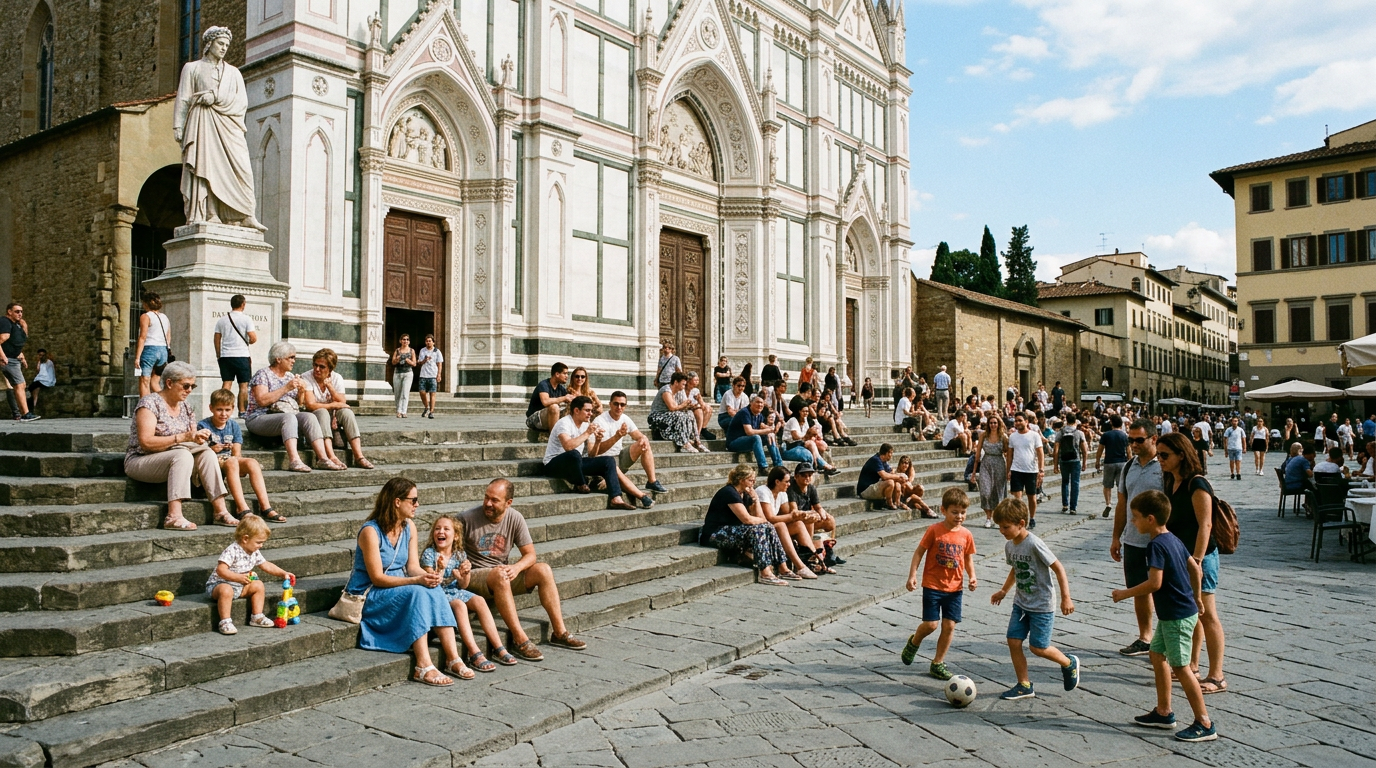
By the time you arrive at Piazza di Santa Croce, you are standing in one of the most remarkable squares in Italy. The piazza is enormous and, unusually for a medieval city that generally packs everything tightly together, surprisingly open. Three sides are lined with palaces and former merchant houses; the fourth side is the white and green marble facade of the basilica. The centre of the square is almost empty of permanent furniture - no market stalls, no kiosks, no outdoor cafe tables covering the stones. Children can run across it freely. That sounds trivial until you have spent several days managing narrow, crowded streets.
The neighbourhood extending behind and around the piazza - toward Via dei Macci, Via delle Pinzochere, and the Sant’Ambrogio market further north - has a genuinely lived-in quality. The food is good, the artisan businesses are serious, and the tourist density, while increasing, has not yet erased the neighbourhood’s own character.
Inside the basilica: making the visit work for children
The Basilica di Santa Croce is the world’s largest Franciscan church, completed in the fourteenth century. The Gothic marble facade was added in the nineteenth century, which is why it looks slightly different in character from the medieval interior - Victorian Gothic rather than medieval Florentine. Both have their own quality.
Inside, the scale is striking: the nave runs for over a hundred metres, and the light from the large lancet windows falls differently depending on the time of day. The floor is almost entirely covered in tombstones, several hundred of them, belonging to Florentine citizens of every rank and era.
The most effective way into the basilica for children is through the famous tombs. Michelangelo is buried here - he died in Rome in 1564 aged 88, and his body was smuggled back to Florence concealed in a wool merchant’s cart because the Florentines were determined to have him. Galileo Galilei’s tomb is on the opposite side of the nave. Niccolò Machiavelli’s is nearby. The Cenotaph of Dante is a monument built to the city’s long guilt about having exiled the poet; he is actually buried in Ravenna and refused to return to Florence even in death. Running through a handful of these stories as you walk down the nave keeps children genuinely engaged in a way that conventional art-historical commentary does not.
The Museo dell’Opera di Santa Croce, accessible through the beautiful first cloister, contains Cimabue’s Crucifix - one of the most significant paintings in Italian history, and one of the most severely damaged by the November 1966 Arno flood, when four metres of mud and water entered the building. The story of the flood and the subsequent restoration effort, in which Florentine students and international volunteers worked around the clock to save artworks, is gripping for children from about nine upward. Entry covers the basilica, the cloisters, and the museum: about eight euros for adults, free for children under eleven.
Open space and green areas for families
The piazza itself is the most obvious place to let children decompress after the basilica. It is large, flat, and used by local families on most afternoons. In June it hosts the Calcio Storico tournament - a medieval football game played on a sand pitch, brutal and spectacular, with teams from Florence’s four historic quarters. If your visit coincides with June, it is worth attending.
The Giardino delle Rose on Viale Giuseppe Poggi is about fifteen minutes on foot, heading along the Lungarno toward the hills below Piazzale Michelangelo. It is a terraced garden with roses of every variety, wide views over the city, and virtually no crowds by Florentine standards. Entry is free. It is open from April to October. There is no playground, but older children enjoy the terraces and the panorama.
Parco delle Cascine, Florence’s main park, is about twenty-five minutes on foot westward along the Arno, or ten minutes by bike. It has proper playgrounds, cycling paths, a pool in summer, and a long riverside promenade. For families with children under eight who need space to run and equipment to climb, Cascine is the right answer.
The streets around Piazza dei Ciompi and the Sant’Ambrogio market, about ten minutes north of Piazza Santa Croce, are another dimension of the neighbourhood worth exploring. The Sant’Ambrogio covered market (open from seven to two, Monday to Saturday) is a proper food market where locals shop, with lower prices and less tourist traffic than the Mercato Centrale.
Where to eat and drink as a family
Gelateria dei Neri on Via dei Neri has been one of Florence’s best gelaterie for decades. The queue often extends out of the door, which is a reliable indicator of quality. Two generous scoops cost about three euros. The flavours rotate seasonally; the dark chocolate and the stracciatella are constants.
Brac on Via dei Vagellai is a vegetarian restaurant set inside a second-hand bookshop. The food is creative and seasonal; the atmosphere is relaxed and bookish. Children who like exploring shelves full of old books will be occupied. Dinner for two adults runs to about thirty-five euros. A good option for a quieter evening.
Trattoria Cibreo on Via dei Macci serves refined Tuscan cooking in an atmosphere that is considered but not stiff. Average price about thirty to forty euros per person. Better suited to children from age seven or eight upward who can manage a longer, slower dinner.
For pizza without any ceremony, the streets around Via delle Pinzochere and Via dei Bentaccordi have several local pizzerias that are not featured in tourist guides and are consequently much better value than those on the main tourist routes near the piazza. Walk down and look for a chalkboard menu outside and a room that is at least two-thirds full of Florentines.
Il Latini on Via dei Palchetti is a ten-minute walk from Piazza Santa Croce, toward the Arno. Large shared tables, no reservations, a queue that forms outside from about seven in the evening. Hearty Florentine cooking and a lively, communal atmosphere that suits families with children from five or six upward.
Getting here from Santa Maria Novella
From the Duomo, Piazza Santa Croce is about a ten-minute walk. The direct route goes along Via dei Calzaiuoli and then Via dei Benci. From Charlotte on Via Guido Monaco 19, allow about fifteen minutes on foot - through the heart of the historic centre, past the Bargello, and out into the square. The C2 minibus also covers this route and stops close to the basilica.
Charlotte is a natural base for exploring Santa Croce, which is close enough to visit several times across a stay - in the morning for the basilica, in the late afternoon for the square, in the evening for dinner. Plan your stay at Charlotte.