Summer Activities for Children in Florence
July and August in Florence are genuinely hot - daytime temperatures regularly reach 34 to 36 degrees Celsius, and in peak periods they push above 38. The city is also busier than at any other point in the year, with queues outside the major museums that can stretch 45 minutes or more by mid-morning. None of this makes a summer visit impossible. It makes it something you plan around rather than drift into.
Families who have good summers in Florence tend to be the ones who treat the heat as a given and structure the day accordingly: early mornings, a genuine midday rest, and evenings that extend later than they would at home. The city is strikingly pleasant after 19:00, when the temperature drops several degrees and the light over the Arno turns gold.
Structured summer programmes for children
Several Florence museums and cultural organisations run children’s programmes between June and August, which gives visiting families access to structured activities that go well beyond a typical tourist visit.
The Museo dei Ragazzi at Palazzo Vecchio runs its most intensive summer programme during this period. Children between 5 and 14 can join week-long sessions that run from Monday to Friday, 09:00 to 13:00, combining theatrical guided visits through the palace rooms with hands-on creative workshops. The focus is on the Medici family and the history of Renaissance Florence, presented as an adventure rather than a lecture. Fees in 2026 are approximately 120 to 150 euros per child per week. Places fill up, so booking in May is advisable.
The Stazione Leopolda, a converted railway building near the Cascine park, hosts summer workshops in art, music, and performance for children. Sessions are typically half-day or full-day, priced between 20 and 45 euros. The programme varies annually - check the Stazione Leopolda website in spring for the current summer schedule.
Private language schools in Florence offer summer courses for children aged 7 to 16 that pair Italian language learning with cultural visits and art history. These are useful for families staying a week or more who want a structured morning activity alongside general sightseeing. Several schools near the city centre run these programmes; a week-long course typically costs between 200 and 350 euros per child.
The Comune di Firenze also operates Centri Estivi - municipal summer centres at local schools and sports facilities, aimed primarily at resident children but occasionally accessible to registered visitors. Contact the Comune’s education office directly to check eligibility for non-resident families.
Indoor refuges from the heat
Between noon and four in the afternoon, the most sensible policy with children in a Florentine summer is to be inside somewhere cool. Several locations work particularly well as extended midday stops.
The Museo di Storia Naturale on Via Romana is housed in a thick-walled historic building that maintains a comfortable temperature even on the hottest days. The La Specola section, with its extraordinary collection of eighteenth-century anatomical wax figures, holds the attention of children between about 9 and 14 with a certainty that few conventional museums can match. It is one of the genuinely strange and memorable places in Florence, and rarely overcrowded.
The upper level of the Mercato Centrale food hall on Via dell’Ariento is air-conditioned, open until midnight, and full of excellent food vendors. An extended lunch here - with time to browse the stalls, rest at a table, and wait for the worst of the afternoon heat to pass - is one of the most practical and enjoyable midday strategies available in the city centre.
The Biblioteca delle Oblate, a public library about 200 metres east of the Duomo on Via dell’Oriuolo, has air conditioning throughout and a spectacular free rooftop terrace on the fourth floor with a direct view of the cathedral dome. Entry to the library is free. It is quiet, cool, and genuinely peaceful - a welcome contrast to the crowds outside.
The San Marco cloister, attached to the Museo di San Marco near Piazza San Marco, has a shaded garden courtyard with large trees. Museum entry is around 8 euros per adult; children under 18 from EU countries enter free. The courtyard is one of the calmer spots in the city on a summer afternoon.
Beach days by train
The Tyrrhenian coast is within comfortable train reach of Florence, making a beach day from the city centre a realistic option rather than a theoretical one.
Viareggio is the closest beach town, roughly 90 kilometres from Florence. Regional train services from Santa Maria Novella run in 60 to 75 minutes and depart frequently throughout the day. A return adult ticket costs approximately 15 to 20 euros; children between 4 and 11 pay half price. Viareggio has a long sandy beach divided between free public sections (spiaggia libera) and private beach clubs. A day at a beach club - two sun loungers and an umbrella - costs between 20 and 35 euros. The free sections lie north of the main town and are walkable from the station in about 20 minutes.
Marina di Pisa offers a quieter alternative at a similar distance. Take the fast train to Pisa Centrale (around 60 minutes), then a local bus to the beach (around 30 minutes). The atmosphere here is more relaxed and the beach less crowded than Viareggio.
Castiglioncello, south of Livorno at roughly 115 kilometres from Florence, is a smaller rocky cove reached by train in approximately 90 minutes. The water is clear and the beach is never overwhelmingly busy. A good option for families who want something less resort-like.
Managing the heat day by day
The practical rhythm of a successful summer day in Florence looks something like this: out of the accommodation by eight for a walk or a museum visit while the streets are still in shadow; back inside or near water by noon; rested and ready to go again from five. The children who thrive in this city in summer are the ones who get gelato at ten in the morning, nap after lunch, and stay up to see the Arno at dusk.
Water is the central practical consideration. Children dehydrate faster than adults in sustained heat. Florence has numerous public drinking fountains - the small iron spigots called nasoni - throughout the city streets and piazze. The water is clean, cold, and free. Keep a bottle per child and refill frequently.
Hats and light colours matter more than most families initially realise. Open piazze like Piazza della Repubblica and Piazza del Duomo are surrounded by stone that absorbs and radiates heat; walking through them at midday in dark clothing feels measurably worse than the same walk at the same temperature in the shade of a narrow street.
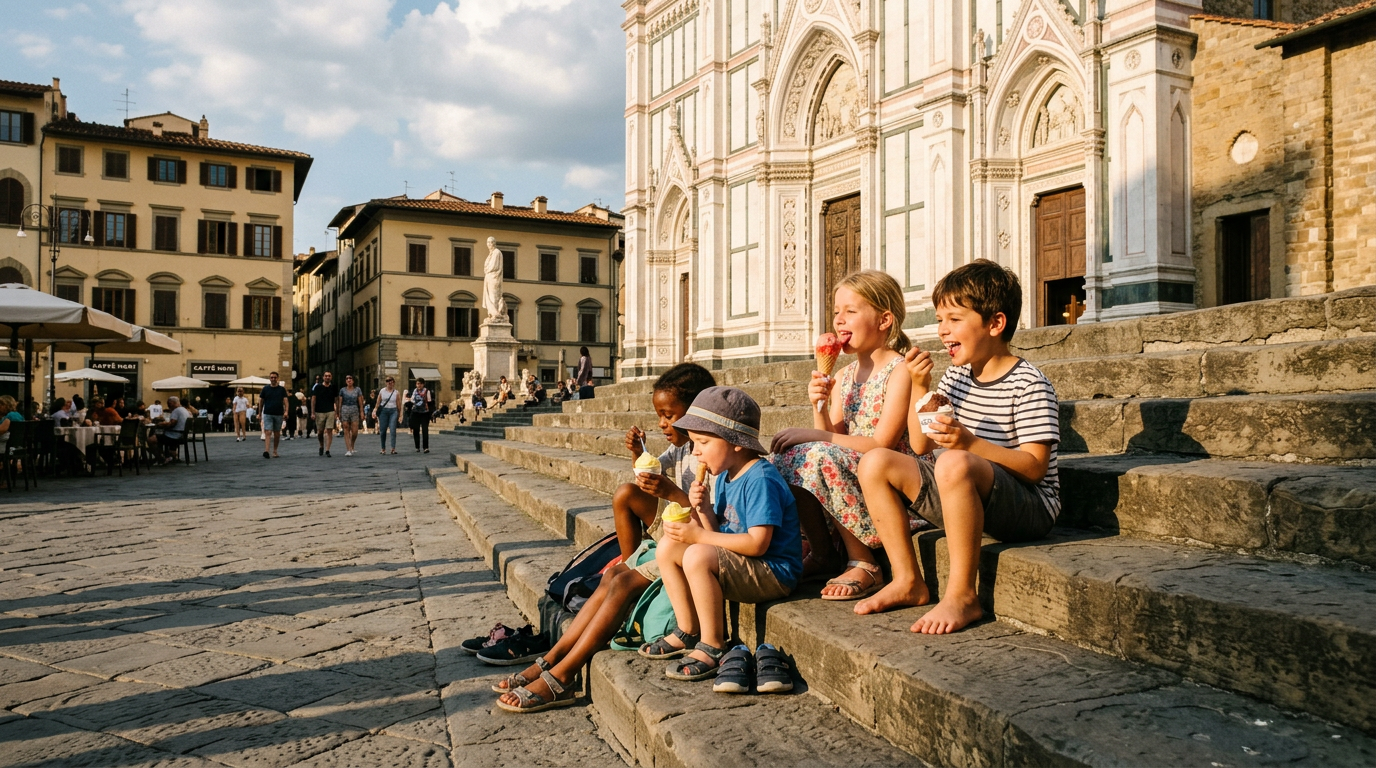
Good gelato - from an artisan gelateria rather than the mounded-display tourist operations near the main monuments - is a genuinely effective tool for a hot afternoon. The cold and the sugar and the few minutes sitting down all contribute something real. Expect to pay around 2.50 to 3.50 euros for a small cup; more near the Duomo, less in neighbourhood streets.
The evening walk along the Arno embankment - from Ponte Vecchio west towards Ponte alle Grazie and back - is one of the most consistently pleasant things Florence offers a family in summer. Twenty-five minutes at a comfortable pace, golden light on the water, and the heat finally dropping. If you are staying close to the centre at Charlotte, Via Guido Monaco 19, you can be at the river in under ten minutes and still have the evening ahead of you.