Museums in Florence Suitable for Children
The honest answer to “which Florence museums work with children?” is: not all of them, but more than you might think, and the selection matters enormously. Taking a seven-year-old through every room of the Uffizi is a particular kind of family experience - not necessarily a good one. Taking the same child on a theatrical guided visit through Palazzo Vecchio, where they are handed a costume and asked to help uncover a Medici family secret, is something else entirely. The museum is the same city. The choice makes all the difference.
Palazzo Vecchio and the Museo dei Ragazzi
This is the starting point for any family with children between 5 and 14 visiting Florence. The Museo dei Ragazzi operates within Palazzo Vecchio - the imposing medieval town hall on Piazza della Signoria - and its approach is completely unlike a conventional exhibition. Children do not walk through glass cases and read labels. They become participants in a theatrical story set in the palace rooms themselves.
The two most popular programmes in 2026 are “The Secret of the Duke,” which is pitched at ages 5 to 10, and “Cloaks and Daggers,” designed for children between 9 and 14. Both use the history of the Medici family as the raw material for what amounts to a guided adventure, with costumed actors and genuine access to rooms of the palace that most visitors walk past. Sessions run approximately 75 minutes and English-language versions are available, though they must be booked at least a week ahead during high season.
Children’s programme tickets cost around 6 euros per child. Adults accompanying children pay standard Palazzo Vecchio entry, which in 2026 is approximately 12.50 euros per person. A combined family rate covering two adults and two children runs around 22 euros - confirm the exact figure on the official Comune di Firenze website before booking, as pricing is updated each year. The recommended minimum age is five; younger children are welcome but tend to find the 75-minute sessions difficult to sustain.
The Uffizi and the Accademia: how to approach them with children
Both of these are world-class institutions that are also, in their standard form, demanding for children under twelve. The key in both cases is targeted visiting: choosing a small number of specific works to see rather than attempting anything comprehensive.
At the Uffizi, the Botticelli rooms - numbered 10 to 14 - are the most consistently engaging for children old enough to notice what they are looking at. The Primavera and The Birth of Venus both generate questions that adults struggle to answer satisfyingly, which is its own form of success. A focused 90-minute visit to the highlights is far more valuable than a three-hour circuit that ends in exhaustion and resentment. Adult entry in 2026 is 20 euros during peak season (March through October); children under 18 from EU countries enter free. Pre-booking online is essential - queues without a timed ticket can exceed an hour at peak times.
The Accademia is a shorter visit by nature. The David is the focus and it justifies the journey on its own. Michelangelo’s sculpture stands 5.17 metres tall, and the gap between what children expect from a photograph and what they encounter in person is reliably significant. Allow 45 to 60 minutes, book tickets online (16 euros per adult in 2026; EU under-18s free), and arrive at your timed slot.
Museums that are genuinely well-suited to younger visitors
Beyond Palazzo Vecchio, several Florence museums offer experiences that do not require sustained concentration or a long attention span.
The Museo di Storia Naturale - specifically the La Specola section on Via Romana - contains one of the strangest and most compelling collections in the city: eighteenth-century anatomical models in wax, made to a standard of detail that remains remarkable. Children between 8 and 14 tend to be simultaneously appalled and fascinated. The museum is small, unhurried, and a welcome alternative to the crowded civic institutions.
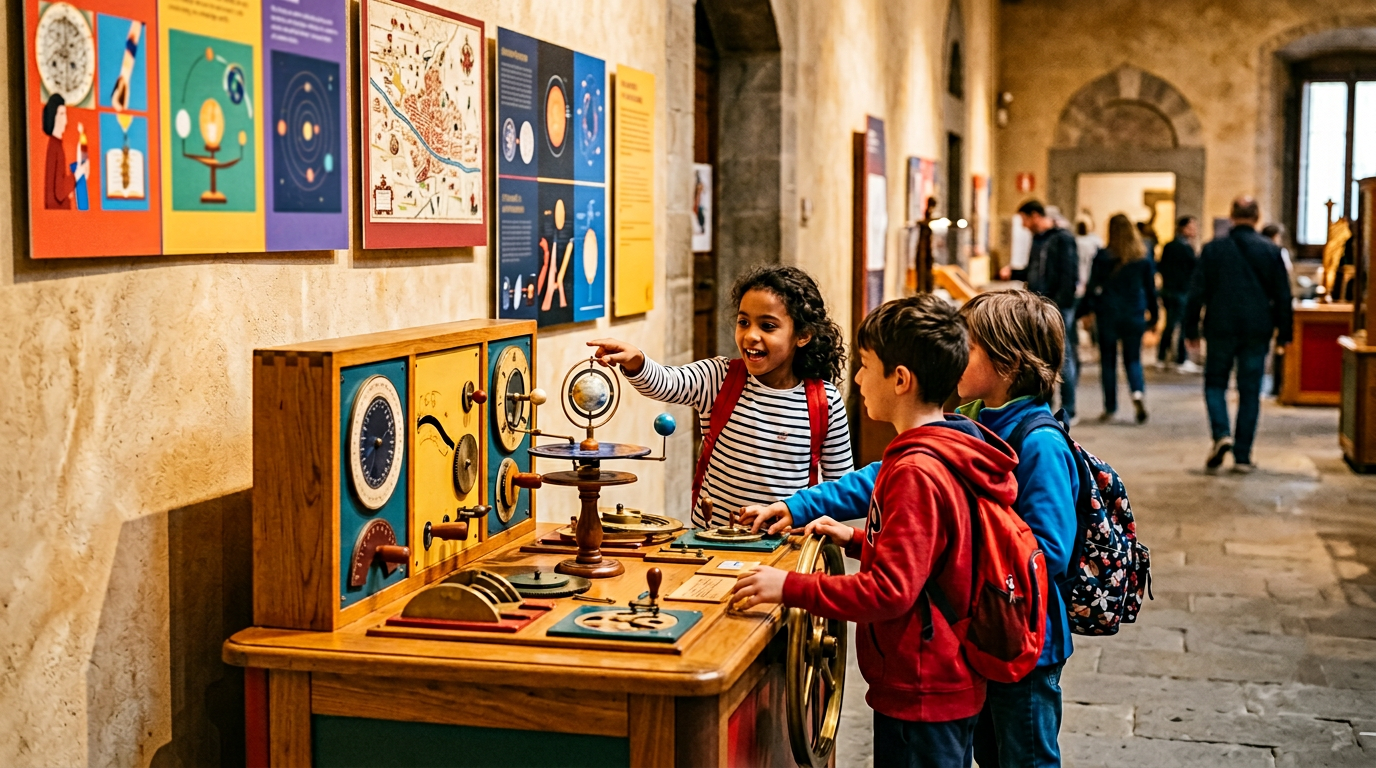
The Museo Galileo, on the south bank of the Arno near the Uffizi, houses Galileo’s original telescopes, astrolabes, and scientific instruments. It is well laid out for younger visitors, with models that illustrate how instruments work rather than simply displaying them. The room containing Galileo’s preserved middle finger in a glass reliquary generates a reliable reaction from children in the 8-to-12 range. Entry is around 10 euros per adult; children under 6 enter free.
The Stibbert Museum, in the northern part of the city near Fortezza da Basso, holds one of the world’s largest private collections of historic armour and weapons. The centrepiece is a room of full-scale equestrian figures in complete armour - horses and riders - that creates an atmosphere somewhere between museum and theatre. Children who respond to knights and battles find this absorbing. Note that the Stibbert closes on Wednesdays.
Tickets, pricing, and the free entry rules
Italy has a consistent national policy granting free entry to all EU citizens under 18 at state-owned museums. This covers the Uffizi, the Accademia, the Bargello, Palazzo Pitti, and the Boboli Garden in Florence. Non-EU children pay standard rates. For a family of two adults and two non-EU children, a single Florence museum visit typically costs between 35 and 50 euros.
The first Sunday of every month is free entry day at all Italian state museums. Queues on these days are significantly longer than usual; arriving by 08:30 - doors open at 08:15 - is the best strategy for keeping the wait under 20 minutes.
The Firenze Card is a 72-hour pass covering more than 70 sites in Florence, priced at around 85 euros per adult in 2026. For families visiting four or more museums in three days, it offers reasonable value. EU children under 18 do not need it for state museums, but having the card for adults removes the need to queue for tickets separately at each site.
Keeping children engaged: approaches that work
The most effective thing you can do before any museum visit is give children a specific goal rather than a general instruction to “look at the art.” Ask them to find the youngest person in any painting in the room. Ask them to identify one thing they have never seen before. Give a sketchbook and a request to draw a single face or object they choose themselves. These small interventions change the experience from passive observation to active participation, and the difference in engagement is immediate and measurable.
Timing matters more than most families account for. Children between 5 and 12 generally have better concentration before midday. An afternoon museum visit after lunch in summer, when temperatures are high and energy is lower, is significantly harder to manage than a morning visit on the same child’s best day. Book morning slots where possible.
Arrive before 09:30 at the Uffizi or the Accademia and you will have noticeably emptier rooms for the first 45 minutes. After 10:00 the numbers build quickly.
Plan the museum shop as the reward at the end of the visit, not the beginning. Children who know there is something to choose at the end of a visit tend to be more cooperative throughout. The Uffizi shop carries good-quality postcards and small reproductions from around 1.50 euros - more than enough of a reward for a patient morning.
For a family base that puts you within easy walking distance of Palazzo Vecchio, the Uffizi, and the Accademia - with no need for buses or taxis on museum mornings - Charlotte is five minutes from Santa Maria Novella station and ten minutes on foot from Piazza della Signoria.