What to Expect at the Boboli Garden with Children
The garden behind the palace: what it actually is
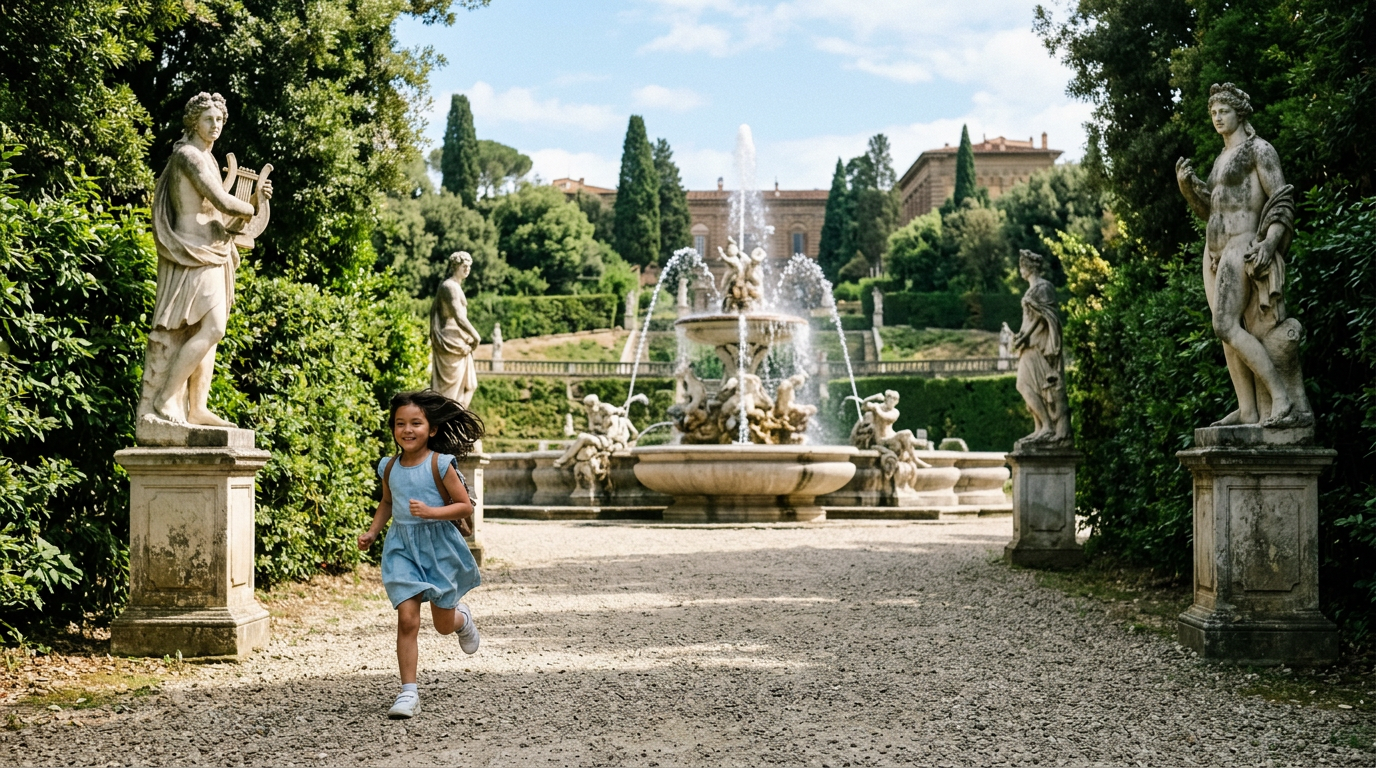
The Boboli Garden is not a park in any conventional sense. It is a four-century-old designed landscape that covers roughly forty-five thousand square metres of the Oltrarno hillside behind Palazzo Pitti. The Medici family began shaping it in 1549, and every subsequent generation of Florentine rulers added something: a new terrace, a fountain, a grotto, an avenue of stone statues. The result is an outdoor museum of landscape design, sculpture, and Renaissance and Baroque garden theory.
For families with children, this is actually a good thing rather than an intimidating one. The variety of experiences within the garden - steep wooded paths, formal geometric hedgerows, a pond with an island, a sixteenth-century artificial cave, panoramic terraces, classical statues half-hidden in vegetation - means that different children find different things that grab their attention. It is not a garden you can exhaust in an hour.
The practical facts first: the garden is open every day except the first and last Monday of each month. In 2026, opening hours run from 08:15 to approximately one hour before sunset, which means closing times range from 16:30 in January and February to 19:30 in June and July. Confirm the exact closing time on the official Polo Museale della Toscana website before visiting.
Admission, free days, and smart ticketing
Entry to the Boboli Garden is included in the Palazzo Pitti combined ticket, which costs approximately sixteen euros per adult in 2026 and covers the Palatine Gallery, the Modern Art Gallery, and the garden itself. Children under eighteen who are citizens of EU member states enter free. Non-EU children between six and seventeen pay a reduced rate of about two euros. Children under six enter free regardless of nationality.
The first Sunday of each month is free entry at all Italian state museums and heritage sites, including Boboli. On these days, queues at the main Palazzo Pitti entrance can be substantial. Arriving before nine o’clock is the only reliable strategy for avoiding significant waiting on a free Sunday.
If you plan to visit multiple Florence sites across two or three days, the Firenze Card (eighty-five euros per adult, valid for seventy-two hours) covers the Boboli Garden and Palazzo Pitti among its venues and allows you to skip the main ticket queues. For families who are planning a full programme of museums and gardens, this represents reasonable value.
The least crowded way to enter is through the secondary entrance at Via Romana 37, just inside the Porta Romana gate. This entrance brings you directly into the upper section of the garden and bypasses the Palazzo Pitti ticket queues entirely. The ticket price is the same, but the queue is rarely more than a few minutes long even on busy days.
The highlights that actually hold children’s attention
The Grotto of Buontalenti, near the Pitti entrance, is the single feature most likely to produce a genuine reaction from children. Built in the 1580s by Bernardo Buontalenti for Francesco I de’ Medici, it is a cave-like space decorated with artificial stalactites, shells, pumice stone, and sculptural figures emerging from the walls as if dissolving into stone. The figures were originally works by Michelangelo. The effect is strange, slightly unsettling, and completely unlike anything else in the garden. Children between six and fourteen reliably find it fascinating. It looks like a fairy tale gone slightly wrong, which is precisely what it was meant to be.
The Neptune Fountain, roughly halfway up the central axis, sits in the middle of a reflective pool surrounded by a low stone balustrade. The bronze statue of Neptune was made in the sixteenth century. Children between four and twelve almost always pause here for several minutes - something about the water and the scale of the figure draws attention instinctively.
The Kaffeehaus, an eighteenth-century pavilion at the highest point of the main garden axis, has a viewing terrace that offers one of the finest panoramic views of Florence available without climbing a tower. The Duomo, the Palazzo Vecchio tower, the Arno, and the hills to the north are all visible. The bar inside the Kaffeehaus is open seasonally. Arriving here after a climb through the garden with children has a satisfying quality of achievement.
The Isolotto, a pond with a small island and a central fountain of Perseus and Andromeda, sits at the far western end of the garden, about twenty minutes’ slow walk from the main entrance. The pond is surrounded by lemon trees in enormous terracotta pots. The island is accessible via a narrow bridge. The atmosphere here is quieter than the main central axis, and on weekday mornings in spring or autumn it can feel almost private. For families who reach this point, it is usually the most memorable part of the visit.
How much time to allow
For families with children between five and twelve, ninety minutes to two hours is comfortable. This covers the main central axis, the Grotto of Buontalenti, the Neptune Fountain, and the view from the Kaffeehaus. Adding the Isolotto extends the visit by about forty minutes.
A complete walk of the outer paths, including all secondary routes and terraces, takes about three hours and is more appropriate for older children and teenagers who are comfortable with extended walking on gravel and uneven stone.
The most practical approach for most families: arrive at nine in the morning, allow ninety minutes, and leave before eleven. The garden becomes significantly warmer and more crowded from about eleven o’clock through early afternoon, particularly between May and September.
Practical notes for the visit
The gravel paths throughout the garden are loose in places and slightly slippery on slopes. Shoes with a grip sole are strongly recommended. Sandals without straps cause difficulty on the steeper sections, and this is one of those cases where the guidebook advice turns out to be literally true.
A pushchair is manageable on the main central axis, which is wide and relatively smooth. The steeper side routes and the outer paths are difficult with a pushchair. A carrier or backpack-style child carrier works better for children under two.
Drinking fountains providing safe municipal water are located at two points along the main axis. In warmer months, a refillable bottle is worth carrying. The bar at the Kaffeehaus sells cold drinks and simple snacks at typical museum prices.
Photography is permitted throughout the garden with no restrictions. The best light for photographs of the garden and the city views is before ten in the morning or after four in the afternoon, when the sun is lower and the shadows are longer.
Dogs are permitted in the Boboli Garden on a lead - one of very few major Florentine cultural sites where this is the case.
Charlotte on Via Guido Monaco 19 is a fifteen-minute walk from the Palazzo Pitti entrance, crossing Ponte Vecchio or Ponte Santa Trinita. It is a central position that makes the Boboli Garden straightforwardly accessible without requiring a bus or taxi. Plan your family visit to Florence at Charlotte.