What to Do in Florence with Children
Let me be honest with you: Florence is not an obvious children’s destination. There are no theme parks, no beaches, and the art is mostly behind glass in rooms where shouting is frowned upon. What Florence does have, and what surprises almost every family that visits, is scale. The cathedral dome is genuinely enormous. The tower of the Palazzo Vecchio disappears into the sky. The streets are narrow enough for children to feel enclosed in something ancient. Six-year-olds do not stand in front of Ponte Vecchio wondering what it is - they work it out, and they remember it for years. The trick is not choosing the right museums. It is choosing the right pace.
Things that genuinely work for younger children
Children under seven do not need curated children’s programming to enjoy Florence. They need sensory richness, short distances, and something that moves or sparkles.
Ponte Vecchio delivers all three. The bridge takes about twelve minutes to walk across at a child’s pace. The goldsmiths’ workshops on both sides are lit in warm yellow light. The river below is visible through gaps between the shops. Children typically want to cross it twice.
The Mercato Centrale on Via dell’Ariento is one of the most useful stops in the city for families. The ground floor is a working food market - fish, meat, cheese, bread, vegetables, all in open stalls with sensory impact. The first floor food hall is open from ten in the morning until midnight and serves everything from fresh pasta to pizza to Florentine steak. For parents who cannot face another lengthy restaurant with a hungry four-year-old in tow, the food hall is a reliable fallback.
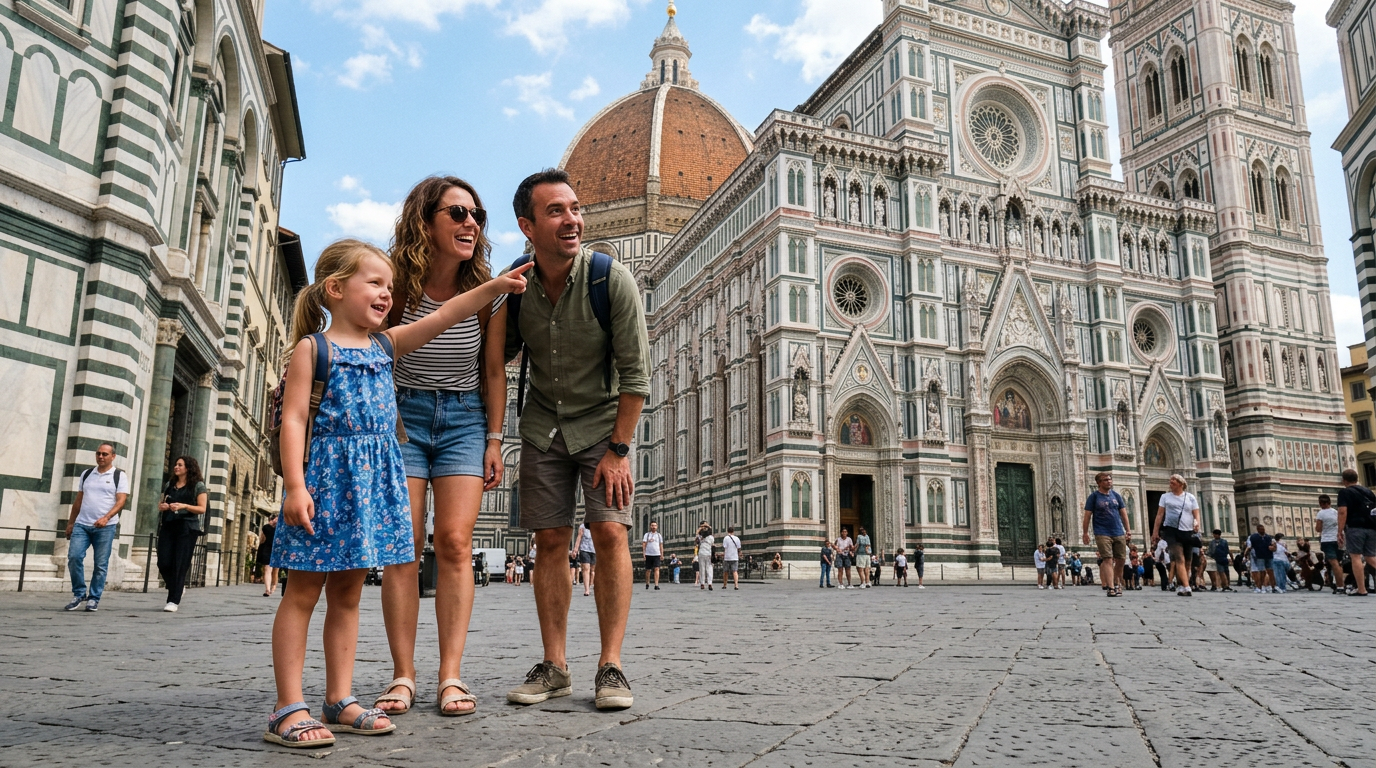
Santa Maria del Fiore - the Duomo - does not require you to go inside with very young children. The exterior alone, with its geometrically patterned marble façade in white, green, and pink, is sufficiently extraordinary to hold a small person’s attention. The Baptistery doors opposite are cast bronze with Biblical scenes in relief. The queue for the dome climb is long but the dome itself is one of the great architectural experiences in Europe, and children aged six and up typically find it thrilling rather than exhausting.
The Stibbert Museum at Via Montughi 14, about three kilometres north of the centre, houses perhaps the finest collection of armour and weaponry in Italy. Rooms of full armoured knights, Japanese samurai suits, Islamic cavalry armour, and mediaeval helmets. For children who respond to knights, warriors, or history of any sort, this is genuinely exceptional. Opening hours in 2026 are Thursday to Tuesday, 10:00 to 14:00. Entry costs €8 per adult and €6 per child. It is quieter than central museums and better suited to the kind of unhurried looking that children actually do.
Museums worth the effort with older children
Children aged eight to fourteen are a different proposition in Florence. They can follow narrative, read a few labels, ask good questions, and sustain interest in a museum for seventy or eighty minutes before saturation sets in.
The Museo dei Ragazzi at Palazzo Vecchio is the most directly relevant institution. The museum runs guided theatrical visits in which children become participants in a story set in the Renaissance palace. The format is not a lecture - it is closer to a live-action adventure. Sessions last approximately seventy-five minutes and are available in English throughout the tourist season. Themes change, but perennial favourites include investigations into the Medici family and the secrets hidden inside the palace walls. Booking is essential between March and October. Cost is around €6 per child, with a combined Palazzo Vecchio family ticket available.
La Specola, part of the Museo di Storia Naturale at Via Romana 17, is not for every child. It contains the most extraordinary collection of 18th-century anatomical wax models in the world - hundreds of full-body figures showing the human body in progressive stages of dissection, originally made to train medical students. Alongside these are rooms of natural history specimens including insects, reptiles, and large mammals. Children between nine and fourteen who are not squeamish tend to find this visit genuinely unforgettable. It is a ten-minute walk from Ponte Vecchio and costs around €6 per adult.
The Uffizi Gallery is worth attempting with children from about age eleven, provided you go selectively rather than exhaustively. Pick six or eight rooms to visit deliberately - the Botticelli room with the Primavera and the Birth of Venus, the room with Leonardo’s Annunciation, and Caravaggio’s Bacchus - and leave. Do not attempt a comprehensive visit with children. The building contains approximately 5,000 works. Spending twenty minutes in eight rooms, then sitting outside in the Loggia dei Lanzi to look at Cellini’s Perseus, is a far better experience than three hours of diminishing returns.
Parks and outdoor spaces for energy recovery
Every family trip to Florence needs at least one park morning or afternoon. Stonework and museums are magnificent, but children need space to run, climb, and be loud without anyone caring.
The Giardino di Boboli behind Palazzo Pitti is the largest and most dramatic. Forty-five thousand square metres of terraced Renaissance garden with fountains, grottos, and long cypress avenues. The Grotto of Buontalenti - a 16th-century artificial cave decorated with petrified figures, shells, and stalactites - is genuinely strange and typically captivates children aged five and up. Entry is €10 per adult in 2026; children under 18 from EU countries enter free. The garden opens at 08:15 and closes at dusk. Go on a weekday morning to avoid the worst of the heat and the crowds.
The Parco delle Cascine stretches 3.5 kilometres along the north bank of the Arno, west of the city centre. It is the largest public park in Florence, free to enter, and contains open lawns, cycling tracks, a public outdoor pool, and a Tuesday morning market. It is reached by tram from Santa Maria Novella station in about fifteen minutes. This is the park for an unstructured half-day rather than a structured visit - bikes can be hired near the park entrance.
The Giardino delle Rose on the hillside below Piazzale Michelangelo is small, terraced, free, and remarkable for its views. On a clear day the Florence skyline from the upper terrace, with the Duomo and the tower of the Palazzo Vecchio visible together, is one of the best views in the city. The garden is open daily from 08:00 to 20:00 in summer. The uphill walk from Porta San Miniato takes about twenty minutes and is manageable for children from age five.
Practical planning for a family trip
Florence’s historic centre is almost entirely pedestrianised. This is good news for walking with children but means that prams and pushchairs encounter uneven stone pavements throughout. A lightweight pushchair handles the main routes. For the narrower streets of Oltrarno or Santa Croce, a child carrier or backpack is more practical.
Public buses use a single fare of €1.70 valid for ninety minutes. A family day ticket costs around €5.50. Children under six travel free. The tram from Santa Maria Novella to Le Cascine takes about fifteen minutes and runs frequently. Tickets must be bought before boarding - from tabacchi shops, newsstands, or machines at main stops.
Timing the day around the midday heat (14:00 to 16:30 in July and August) is not optional with young children. Plan one major morning activity, a genuine rest in the middle of the day, and a lighter afternoon. Families who resist this logic typically hit a wall around 15:00 on day two and spend the afternoon managing unhappy children in a crowded gelateria. Those who embrace the rhythm find that the evenings become properly enjoyable: a walk to Piazza Santo Spirito, dinner outdoors at a local trattoria, a final gelato from a proper artisan shop like Gelateria dei Neri on Via dei Neri.
For gelato, look for the words artigianale or produzione propria above the counter. These indicate house-made gelato rather than the bought-in varieties that fill the overlit tourist shops. Servings cost €2.50 to €4 depending on size.
A base that makes the pace manageable
Everything in this guide is walkable or easily reachable by tram from the right central address. Charlotte is at Via Guido Monaco 19, five minutes from Santa Maria Novella station on foot, with the Duomo, Ponte Vecchio, and Oltrarno all within fifteen minutes on foot. When children need an unplanned rest, or when the day’s plan changes because of weather or energy levels, being able to return to comfortable central accommodation in minutes is the thing that makes the whole rhythm work. Book your stay with Charlotte.