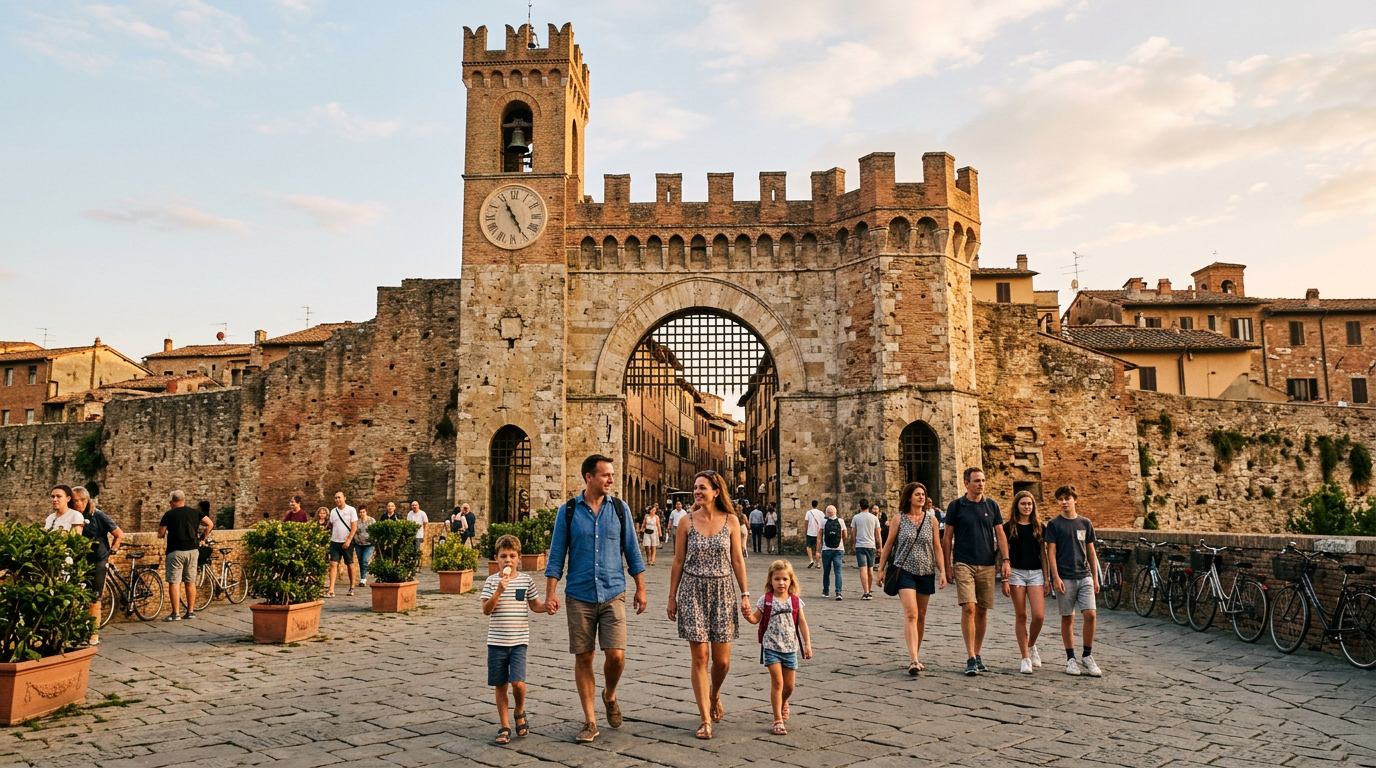
Exploring Porta Romana in Florence with Family
A corner of Florence that feels genuinely Florentine
Most families visiting Florence concentrate their days in the triangle between Santa Maria Novella, the Duomo, and Palazzo Vecchio. This is understandable - the density of remarkable things in that zone is extraordinary - but it means missing some of the city’s most liveable and interesting neighbourhoods. Porta Romana, on the southern edge of the historic centre, is one of them.
The gate itself stands at the end of Via Romana, a wide, straight street that runs south from Ponte Vecchio. It is the largest of Florence’s surviving medieval gates - built from stone and brick, with a double arch and a turret that remains intact - completed in 1328, when Florence was one of the wealthiest and most powerful cities in Europe. The road beyond the gate was the road to Rome, the most important route in the peninsula, and everything about the gate’s scale reflects that significance.
When you arrive at Piazza della Calza, where the gate stands, you notice immediately that you are in a neighbourhood rather than a tourist zone. There are supermarkets, a tabacchi, a pharmacy, a school. Florentine children walk past the ancient gate without a second glance. That contrast between the extraordinary and the everyday is one of the things that makes this part of the city worth visiting with your own children, who tend to find it more striking than anything in a guidebook.
The Boboli Gardens from the entrance nobody uses
Almost everyone who visits the Boboli Gardens enters through Palazzo Pitti. This means queuing on the main Pitti square, buying tickets alongside several hundred other visitors, and entering at the bottom of the garden where the crowds are densest and the atmosphere is most pressured.
There is another entrance entirely, at Via Romana 37, just inside the Porta Romana gate itself. This entrance brings you directly into the upper section of the garden - the part that is hillier, more wooded, and considerably less busy. From here you can walk downhill through the garden toward the Neptune fountain and the Amphitheatre, or take the wider paths that lead out toward the Isolotto at the garden’s far western end. The views from the upper section across Florence’s rooftops are among the finest in the city and require no climbing of towers.
The ticket price is the same: approximately ten euros for adults, free for anyone under eighteen. The difference is purely practical. Arriving at the Porta Romana entrance on a summer morning, you typically walk straight in. At the Palazzo Pitti entrance on the same morning, you might queue for twenty minutes or more. With children, that saved twenty minutes matters considerably.
A useful approach: take bus line 11 down Via Romana to the Piazza della Calza stop, enter the Boboli Gardens from the quiet entrance, walk through the garden downhill toward Palazzo Pitti, exit from the main gate, and cross back into the centre over Ponte Vecchio or Ponte Santa Trinita. The walk takes about ninety minutes at an easy pace and gives you the full garden without retracing a single step.
On the inner walls of the gate itself, there is a 14th-century votive fresco of the Madonna and Child, still legible if you know to look. A useful prompt for children: this gate was like a medieval border crossing. Before you could enter the city, you had to declare who you were and what goods you were carrying. Customs officers taxed everything. The fresco was there so travellers could say a prayer before the interrogation.
What the neighbourhood offers families on a practical level
The streets around Porta Romana have a functional, unpretentious quality that is actually very useful when you are travelling with children. Unlike the tourist zones closer to the Duomo, prices reflect what Florentines actually pay rather than what the tourist trade can sustain. A coffee at a bar on Via Romana costs about one euro twenty. A cornetto costs one euro. A proper lunch at one of the local trattorias runs ten to twelve euros per person rather than the twenty-five you might pay closer to Ponte Vecchio.
There is a Conad supermarket on Via Romana where you can buy water, fruit, cheese, and bread for a picnic in the Boboli Gardens - both cheaper and more enjoyable than eating at the garden’s bar. The Giardino delle Rose on Viale Poggi is a short walk away: a terraced garden with panoramic views over Florence’s rooftops, free entry, and barely any foot traffic compared to the main tourist sites. It is open from April to October.
Children who have been navigating the crowded streets of the historic centre for several days tend to visibly relax in this neighbourhood. The pavements are wider, the traffic is calmer, and there is no sense of being funnelled through a tourist corridor. That is worth something on a long family holiday.
Getting there and back on foot, bus, or bike
From Charlotte on Via Guido Monaco 19 - five minutes’ walk from Santa Maria Novella station - Porta Romana is reachable on foot in about thirty to thirty-five minutes. The route crosses the Arno on Ponte Vecchio, follows Via Guicciardini through the Oltrarno, and continues down Via Romana to the gate. It passes through several distinct neighbourhood characters: the busy commercial zone around Ponte Vecchio, the quieter residential Oltrarno streets, and the increasingly calm area toward the south. It is an enjoyable walk in its own right.
Bus line 11 runs from the city centre down Via Romana, stopping at Piazza della Calza. The journey takes about fifteen minutes. The C3 minibus covers the Oltrarno and connects different parts of the city’s south side.
By bike: the route from Ponte Vecchio to Porta Romana is essentially flat. Florence’s bike-sharing stations (Nextbike) have docking points near Ponte Vecchio and in the Oltrarno. The ride takes about ten minutes.
With a pushchair: Via Romana has wide, well-maintained pavements and no steps between the centre and the gate on the main route. The Boboli Gardens’ Porta Romana entrance has a slope rather than a threshold step, and the main paths through the upper garden are wide enough for a double buggy on most sections, though some of the steeper side paths are better tackled with a carrier.
A day built around this part of the city
A practical family day in this part of Florence might run as follows. Start with breakfast at a bar on Via Romana, or bring it from Charlotte where breakfast is included. Take the bus or walk through the Oltrarno. Enter the Boboli Gardens from the Porta Romana entrance before ten, when the garden is at its most peaceful. Allow ninety minutes in the gardens - the upper section, the Neptune fountain, and the Grotto of Buontalenti near the Pitti exit are the three highlights - then exit through Palazzo Pitti. Walk toward Ponte Vecchio for lunch somewhere along Via dei Serragli or around Piazza Santo Spirito, where restaurants have outdoor tables and proper local menus.
This is a day that covers genuine ground without being relentless. Children have outdoor space, something historically interesting, a walk through several neighbourhood characters, and lunch at a place where the food is good and the bill is reasonable. It consistently works well for guests at Charlotte who want to go beyond the standard itinerary.
More about Charlotte and how to plan your stay at Charlotte.