Florence to Prato: A Family Day Trip
Prato is seventeen kilometres from Florence. Take the fast regional train and you arrive in twenty minutes. Most visitors to Tuscany never go there at all, which is their loss and, frankly, your advantage. On a July morning when Florence is loud and full of tour groups, stepping off the train in Prato feels like a genuine relief. Tuscany’s second-largest city has an intact medieval centre, a formidable castle, a museum that explains how the region became wealthy, and a restaurant scene that exists entirely for its own population. That last point matters: the prices are honest and the portions are generous.
The Quickest Journey in Tuscany
Fast regional trains from Florence Santa Maria Novella to Prato Centrale leave every 15 to 20 minutes throughout the day. A single adult ticket costs approximately 3.60 euros - among the cheapest train journeys you will make in the region. Children aged 4 to 12 pay half price. The journey takes 20 to 22 minutes. Even a child who announces they do not enjoy trains will have nothing substantial to complain about before you have arrived.
From Prato Centrale, the historic centre is a 15-minute walk or a short bus ride away. By car from Florence via the A11, the drive takes 20 to 25 minutes. Central car parks near Piazza del Mercato Nuovo charge approximately 2 euros per hour.
The Emperor’s Castle
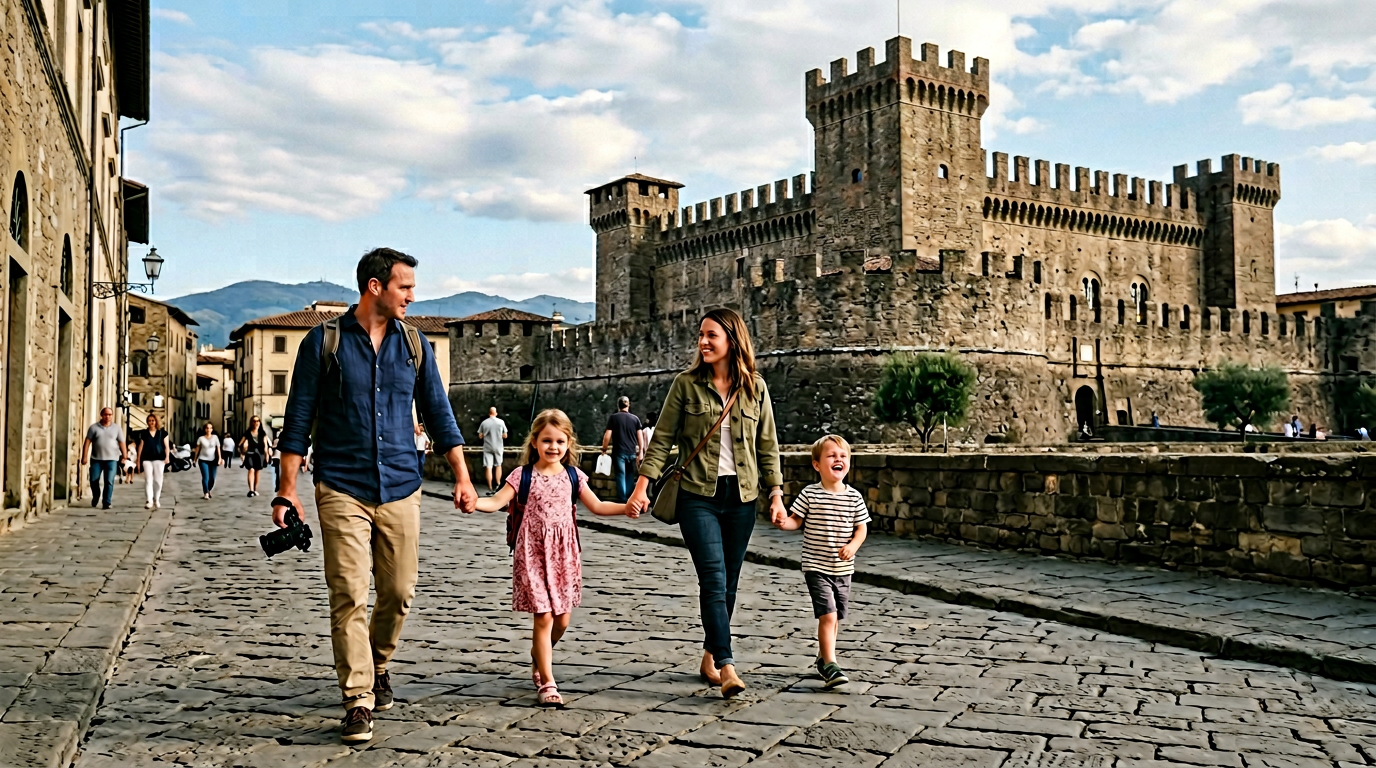
The Castello dell’Imperatore occupies a raised platform in the centre of Prato with a presence that is immediately imposing. It was built in the 13th century by the Holy Roman Emperor Frederick II - a ruler whose dominions stretched from Sicily to the German north - and it remains one of the very few examples of Swabian imperial architecture in central Italy. The exterior is severe and powerful: massive stone walls, square towers at each corner, deep arrow slits, and angular ramparts that have changed remarkably little in 800 years.
The rampart circuit is walkable and takes around 30 to 40 minutes at a relaxed pace. Children aged 6 and upwards who have any natural inclination toward things that are old and fortified respond well to it. The combination of genuine age, serious scale, and a high walkable perimeter makes it more viscerally satisfying than many historically significant buildings that require more imagination to appreciate.
Entry is approximately 4 euros for adults; children under 12 enter free. Open Tuesday to Saturday from 10:00 to 18:00, and Sunday from 10:00 to 13:00. Closed Mondays.
The Textile Museum and the Story Behind Prato
The Museo del Tessuto at Via Puccetti 3, a five-minute walk from the castle, is housed in a 19th-century textile factory and documents Prato’s position as one of the most important textile production centres in Europe - a position the city has held since the medieval period and has never entirely relinquished.
For adults and teenagers, the museum is genuinely interesting. The presentation connects cloth to power, diplomacy, and economic systems in a way that clarifies a great deal about why medieval Florence was as wealthy and culturally prolific as it was. Prato was the engine room of much of that wealth.
For children aged 9 to 14, the museum works best when framed clearly before you go in: textiles are how Florence funded the Renaissance, and Prato was at the centre of that system. With that context in place, the production processes, the historical fabrics, and the machinery make sense as part of a story rather than as objects in a room.
Educational workshops for families run on selected weekends. Entry costs approximately 8 euros for adults and 3 euros for children aged 5 to 17.
The Rest of the Centre
The Piazza del Comune, Prato’s main civic square, holds the Palazzo Pretorio with its distinctive external staircase and the column of the Virgin. It is a handsome space and considerably quieter than any comparable square in Florence. Worth 20 minutes.
Immediately behind the castle, the church of Santa Maria delle Carceri was designed by Giuliano da Sangallo and completed from 1485. It is a small, serene Renaissance building with clean proportions and a luminous interior. The contrast with the massive, martial exterior of the Emperor’s Castle standing metres away is striking. Entry is free and the church takes about 10 minutes to appreciate properly.
Prato is the original home of the cantuccini - the hard almond biscuits sold across Tuscany that most people associate with Florence. Trying them bought fresh from a panifico near the Duomo in the city that invented them is a small but legitimate pleasure. Several pasticcerie and bakeries near the main piazza sell them by weight in paper bags. They travel well and make a better souvenir than most things sold in tourist shops.
Lunch in Prato
Trattoria Lapo near Piazza del Comune serves a daily lunch menu - two courses for approximately 12 to 15 euros per adult - with the sort of cheerful, unselfconscious atmosphere that suggests the restaurant has never particularly thought about whether tourists might turn up. Children are accommodated without fuss.
Ristorante Il Piraña on Via Valentini specialises in fresh fish from the Tyrrhenian coast. More formal in tone and better suited to families with older children or teenagers who eat varied food. Main courses run to approximately 18 to 25 euros.
For the fastest and most affordable option, the forno (bakeries) near the castle sell schiacciata by the slice, focaccia with various fillings, and fresh pastries. A filling lunch for two adults and two children costs around 10 to 15 euros and takes about five minutes to assemble.
A family morning combining the castle (45 minutes) and the textile museum (60 to 90 minutes) leaves you at a natural lunch stop with the afternoon still available - either more of Prato or an early return to Florence. Charlotte is at Via Guido Monaco 19, five minutes from Santa Maria Novella, which makes the return a twenty-minute train ride and no more. Check what’s available at Charlotte.