What to See in Arezzo in a Day
Arezzo sits roughly 80 kilometres southeast of Florence, a fast train journey of between 45 and 55 minutes depending on the service. It receives a fraction of Florence’s tourist traffic, charges accordingly for lunch, and contains at least two genuinely world-class things to see. The historic centre is walkable, steeply sloped, and largely intact as a functioning Aretine city rather than a curated heritage display. Take the morning train, spend the day, and be back in Florence by evening. It is one of the simplest and most rewarding day trips you can make from the city.
Arriving and orienting yourself
Arezzo station sits at the base of the hill on which the medieval city is built. The gap between the station platform and the historic centre is bridged by a free escalator system that lifts you from the lower town to the upper streets in stages. This infrastructure, installed in the early 2000s, is genuinely useful and not something most visitors expect to find in a Tuscan hill town.
From the top of the escalators, the cathedral spire is visible above the rooftops to the northeast and Piazza Grande lies about ten minutes’ walk along the main uphill street, Corso Italia. The street is lined with independent shops - pastry, shoes, local ceramics, antique prints - and is less commercialised than its equivalents in Florence or Siena. It makes for an agreeable approach.
The logical sequence for a day visit is: Piazza Grande first, then the Basilica di San Francesco for Piero della Francesca’s frescoes, then the Cathedral and Parco del Prato, then lunch, then a slower circuit through the streets above Piazza Grande before returning to the station. With children, cut the optional elements and move at their pace. Two or three things seen properly are worth more than six things half-attended.
Piazza Grande and the Vasari loggia
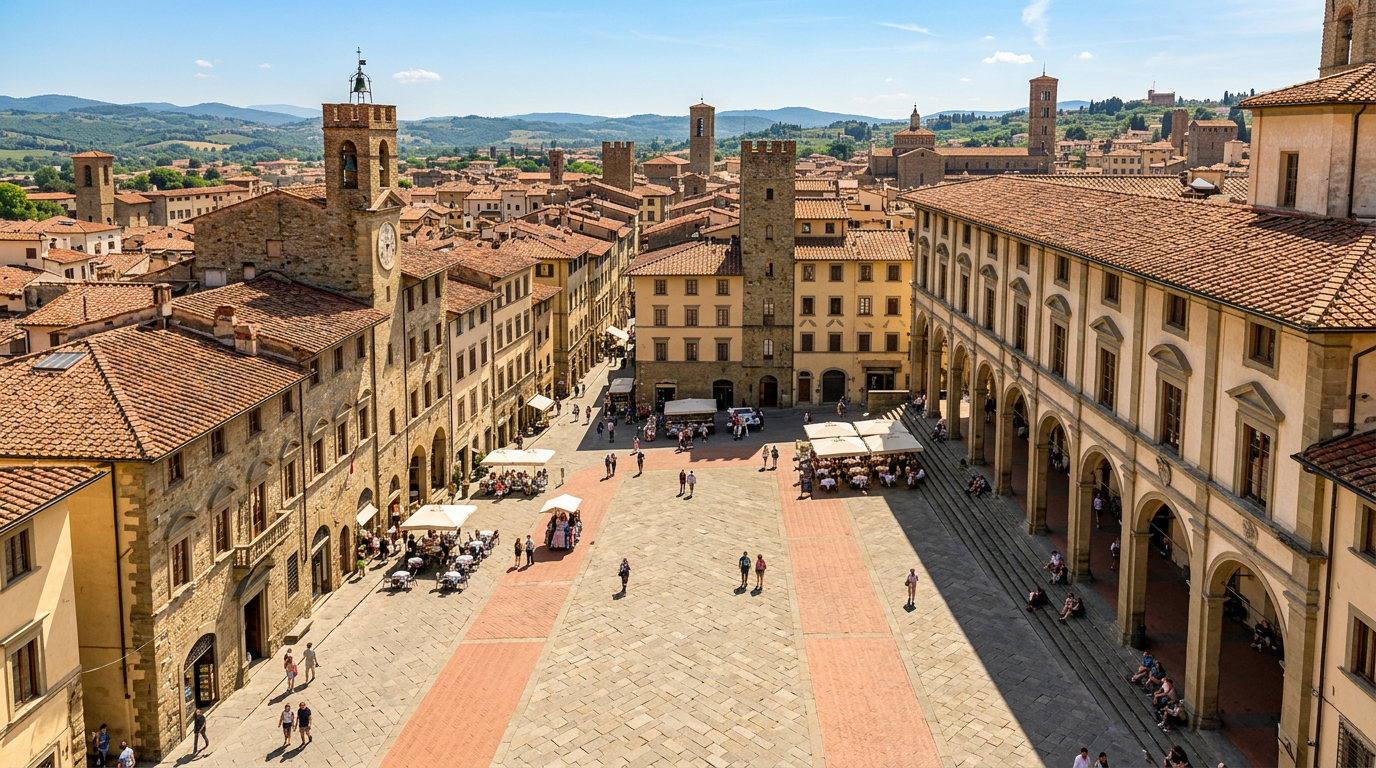
Piazza Grande is the physical and civic heart of Arezzo, and it is unlike any other major piazza in Tuscany. The square slopes visibly: the Vasari loggia end is several metres lower than the opposite flank, giving the whole space a dynamic that flat-paved piazzas cannot replicate. Stand at the high side and look down across it toward the loggia and you understand immediately why this place has the character it does.
The loggia itself was designed by Giorgio Vasari - born in Arezzo in 1511, later the author of Lives of the Artists, the foundational text of Renaissance art history. The ground-floor arcade houses bars and small shops whose stone tables and chairs spill out beneath the arches. It is one of the finer spots for a morning coffee in Tuscany; sit for fifteen minutes and watch the square rather than moving through it.
On the opposing high side, the Pieve di Santa Maria presents a Romanesque façade of stacked open-arched galleries ascending to a summit arcade. The layered rhythm of the stonework is precisely calibrated, and the bell tower rising behind it - the Torre dei Quaranta Campane - is one of the most distinctive silhouettes in the region. The church dates from the 12th century and its interior is worth entering for the polyptych by Pietro Lorenzetti alone.
The first Sunday of every month, Piazza Grande hosts one of Italy’s largest antique markets. Dealers occupy the entire square and spill into surrounding streets with objects ranging from decorative bric-à-brac to genuinely museum-quality furniture. For families with children aged six and above, the market is entertaining and chaotic in the best possible way - old coins, military memorabilia, strange mechanical objects, and hundreds of items that reward unhurried examination. If your visit coincides with the first weekend, plan your departure time around it.
The Basilica di San Francesco and Piero della Francesca
The Basilica di San Francesco stands in the piazza of the same name, a short walk downhill from Piazza Grande toward the lower town. The building’s exterior is unremarkable - a simple Franciscan church of grey stone - and this plainness is deceptive, because the interior contains one of the most important fresco cycles in Italian art.
Piero della Francesca painted the Legend of the True Cross on the apse walls of the Basilica between 1452 and 1466. The cycle covers twelve scenes arranged across three walls, tracing the narrative of the wood from which Christ’s cross was eventually made: beginning with the death of Adam and the burial of a branch from the Tree of Knowledge, through various biblical and historical episodes, to the battles of Constantine and Heraclius. It is a complicated programme, and the narrative order is not chronological but compositional - Piero arranged the scenes for visual balance rather than story sequence.
What makes the frescoes extraordinary is not the subject matter but the manner of their execution. Piero della Francesca was a mathematician as well as a painter, and his work is characterised by an unusual stillness, a precise control of light and spatial geometry, and a palette of muted, almost dusty colours that have survived the centuries in remarkable condition. The figures stand with an absorbed gravity that has no parallel in the more expressive painters of the same period.
Timed entry is required. A maximum of twenty-five visitors are admitted every half-hour. Advance booking is essential during the tourist season - the official booking system for the frescoes is on the Arezzo City Council website. Entry costs approximately €10–12 per adult in 2026. Children under ten often find the frescoes difficult to engage with without preparation; a brief explanation of the narrative beforehand - treating it as a multi-episode story in pictures - makes a substantial difference for children aged ten and above.
The Cathedral, the Parco del Prato, and the streets above
At the highest point of the historic centre stands the Cathedral of Arezzo, a building whose construction spanned several centuries and whose exterior presents a slightly incongruous mixture of Gothic, Romanesque, and incomplete 20th-century elements. The façade is plain to the point of austerity. The interior is more rewarding: the 14th-century stained glass windows on the north wall are among the finest mediaeval examples in Tuscany, attributed to the workshop of Guillaume de Marcillat. The tomb monument of Bishop Guido Tarlati, carved in marble relief by Agostino di Giovanni in the 1330s, fills one wall of the left nave. Entry is free.
Immediately behind the Cathedral, the Parco del Prato opens onto wide grass lawns with views across the Arno valley below the city. The ruins of a Medici fortress from the 16th century mark the southern edge of the park, overgrown and atmospheric in a way that formal restorations rarely achieve. The park has a playground visible from the main lawn. For families who have been walking uphill through a medieval city since mid-morning, the Parco del Prato at lunchtime - open, green, free to enter, with room to run - is a genuinely welcome discovery. A picnic here, bought from the covered market in Piazza Sant’Agostino before arriving, is one of the most straightforward and pleasant lunches available in Arezzo.
The streets in the upper town above Piazza Grande - Via dei Pileati, Via della Colcitronaia, the lanes between the Cathedral and the Badia - reward unhurried walking. The buildings are mediaeval to Renaissance in date, mostly private, and largely unrestored for tourism. Artisan workshops - leatherworkers, a bookbinder, a restorer of antique furniture - occupy ground floors. The absence of managed heritage interpretation is itself notable; Arezzo at this level of the city remains a functioning place rather than a visited one.
Lunch and where to eat in the historic centre
Restaurant prices in Arezzo sit comfortably below Florence levels. A full lunch for two adults with wine costs €35–45 at a traditional trattoria; a family of four with children’s meals manages well under €60 at most places.
Trattoria Il Saraceno on Via Mazzini 6 has been serving Aretine food without significant adjustment for decades. Pici all’aglione - thick hand-rolled pasta in a tomato and garlic sauce - is the dish to order. Tagliatelle with ragù and grilled Chianina beef are the other constants. Simple room, honest pricing, reliable service. Reserve for lunch on weekends.
Osteria dell’Agania at Via Mazzini 10 is a historic dining room with a fixed-price lunch menu that represents very good value. The atmosphere is local and unhurried. This is the right choice if you want to eat well and return to sightseeing without spending ninety minutes over a meal.
Trattoria da Guido on Via Madonna del Prato is the kind of small neighbourhood trattoria that appears in no guidebook but is full of people who work in the surrounding buildings. Ask for directions locally - the address is precise but the street is not prominent on maps. The menu is short and changes with what was available in the market that morning.
For a picnic, the covered market at Piazza Sant’Agostino sells salumi, cheeses, fresh bread, and local agricultural products at prices that make Florence’s central market look expensive. It is the practical starting point for assembling a Parco del Prato lunch.
Using Florence as your base
Arezzo as a day trip from Florence requires almost no advance logistics beyond booking the fresco visit and checking the train timetable. Florence Santa Maria Novella to Arezzo runs hourly on the main Rome line; the journey takes between 45 and 55 minutes; a standard return ticket costs approximately €20–26 per adult and half price for children aged four to eleven. The first departure of the morning from Florence leaves before seven o’clock; the last return from Arezzo in the evening runs past nine. You have the entire day.
Charlotte is five minutes from Santa Maria Novella station on foot. Leave after breakfast, return in time for a late dinner in Florence. That is the shape of the day, and it is a very good one. Find your base at Charlotte.