Certaldo and Boccaccio: A Day Trip with Family
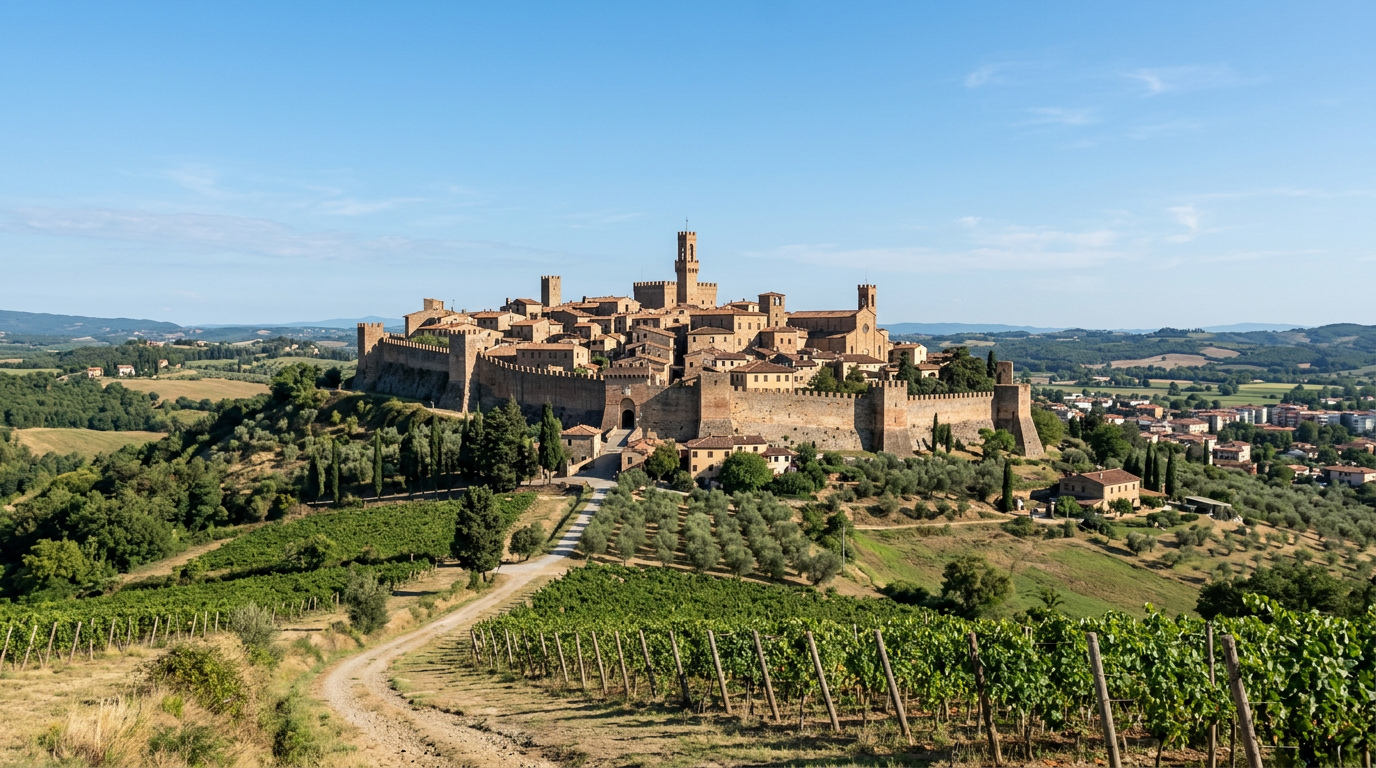
Certaldo is one of those places that genuinely looks the way people imagine medieval Tuscany to look - narrow red-brick lanes, stone towers, the surrounding valley visible on all sides from the top of the hill, and almost nobody selling novelty magnets. It sits 35 kilometres south-west of Florence, takes 45 to 50 minutes by regional train, and makes for one of the most satisfying and manageable day trips available to families based in the city.
The town is the birthplace and final resting place of Giovanni Boccaccio, the fourteenth-century writer whose Decameron is one of the foundational works of European literature. That context is worth carrying with you - not because children need to have read the book, but because the story of Boccaccio’s life is vivid enough to make the village feel inhabited by something beyond tourism.
Who Boccaccio was, and how to explain him to children
Giovanni Boccaccio was born around 1313 - most likely in Certaldo, though the claim is shared with Florence - the illegitimate son of a Florentine banker. His childhood was spent partly in Naples, where his father worked, and this gave him an early exposure to a cosmopolitan, multilingual world that shapes everything he later wrote. He became a scholar and a poet, corresponded with Petrarch, and knew Dante’s work intimately. When the Black Death swept through Italy in 1348 and killed roughly a third of the population, Boccaccio was in Florence and watched it happen.
The Decameron, which he wrote between 1349 and 1353, is built around that catastrophe. Ten young people leave Florence during the plague, take refuge in a country villa, and pass ten days telling one hundred stories - comic, tragic, bawdy, and wise, in roughly equal measure. The book is remarkable partly because its characters are not saints or kings: they are merchants, servants, wives, friars, and clever young women who outwit pompous men. Boccaccio took ordinary life seriously as a subject for literature at a time when almost no one else did.
For children aged 8 to 11, the clearest way to introduce Boccaccio is through the era. He lived through one of the most violent centuries in European history: plague, war, the collapse of major banking houses. He crossed between courts and cities at a time when travel was genuinely dangerous. He was curious about everything and judgmental about very little. That combination is, in fact, rather appealing to children who are old enough to understand it.
For teenagers aged 12 and above, some of the Decameron stories - particularly the shorter, wittier tales in the early sections - are accessible in good English translations and work well as preparation for the visit.
The two parts of Certaldo and what to expect in each
Certaldo divides into two distinct sections: Certaldo Basso, the modern lower town where the train station is, and Certaldo Alto, the medieval walled village on the hilltop above.
Certaldo Basso is functional rather than scenic. From the station, you walk a few minutes to the bottom of the funicular - a small cable car that runs continuously throughout the day, costs approximately 1 euro each way, and takes about two minutes to reach the top. Alternatively, Via Boccaccio winds up the hillside on foot in around 20 minutes if the children have energy and the day is not too hot. The funicular is more reliable with young children.
Certaldo Alto is the reason you came. The village is entirely contained within medieval walls, built from the warm red brick that characterises this part of the Valdelsa. The streets are narrow enough that two people walking abreast nearly fill them. There are no cars. The towers are intact. The silence, particularly on weekday mornings, is genuine. Children who have spent days in crowded Florence find this striking.
The Casa del Boccaccio and the Palazzo Pretorio
The Casa del Boccaccio is the house where Boccaccio returned to live in his later years and where he died in 1375. It now operates as a museum holding early printed editions of his works, manuscripts, and period furnishings. Entry costs approximately 5 euros per adult. For children and teenagers with some context about who Boccaccio was, the visit works well as a short stop of 30 to 40 minutes. For very young children, the rooms of old books behind glass require a different approach - treat it as a chance to look at what a medieval scholar’s home actually contained and tell the story as you walk around.
The Palazzo Pretorio, the 13th-century medieval town hall, is the other major site. Its exterior facade is covered with terracotta and marble coats of arms - the heraldic symbols of the Florentine officials who governed Certaldo over the centuries - and the effect is unusual enough to stop children in their tracks. Entry is around 5 euros. The interior has frescoed rooms open to visitors, and a tower that can be climbed for a view over the Val d’Elsa that on a clear day reaches beyond Siena.
Opening hours for both sites follow seasonal patterns. From April to October they are generally open daily from 10:00 to 19:00; from November to March opening is typically limited to weekends and public holidays. Always check the current hours on the Certaldo municipality website before travelling.
Getting from Florence to Certaldo
By train from Santa Maria Novella: regional services on the Florence-Siena line stop at Certaldo. The journey takes 45 to 50 minutes and costs approximately 6 to 7 euros per adult each way. Children under 4 travel free; children from 4 to 12 pay half fare. From Certaldo Basso station, the funicular to Certaldo Alto is a five-minute walk.
By car: take the Florence-Siena dual carriageway (superstrada) and exit at Poggibonsi Nord, then follow signs to Certaldo. Total distance is around 35 kilometres, and the drive takes roughly 40 to 45 minutes. Free parking is available near the station in Certaldo Basso.
A popular option for families with a full day available is to combine Certaldo with San Gimignano, which is 12 kilometres further along the same road. Morning in Certaldo - quieter, less visited, more intimate - followed by lunch and an afternoon among San Gimignano’s famous towers makes for a varied and satisfying day out. If you are driving this circuit, allow a full day and return to Florence in the early evening.
Making the most of the visit with children
Certaldo Alto is small enough to walk in its entirety in around an hour without rushing. The best approach with children is to build in unstructured time: the narrow streets reward wandering, and children exploring a genuinely medieval village without a fixed agenda often engage more directly with the place than they do on a formally guided circuit.
Bring a picnic if you can. There are very few food options inside Certaldo Alto itself, and a lunch eaten on the walls with the Valdelsa spread below is a considerably better experience than hunting for a table in a place with limited restaurant choice. Certaldo Basso has a small alimentari near the station where you can put something together before taking the funicular up.
The village is at its best in late autumn and spring - October, November, March, April - when the light is clear, the crowds are thin, and the hill colours are at their most dramatic. In summer it is pleasant enough but warmer than you might expect on the exposed hillside. Bring water regardless of season.
For a family spending several days exploring Tuscany beyond Florence, a combination of city days and day trips to places like Certaldo gives the holiday a shape that children find satisfying. If you want a Florence base that makes both easy - close to the train station for Certaldo, well placed for the motorway for the longer drives - Charlotte at Via Guido Monaco 19 is five minutes from Santa Maria Novella on foot and a comfortable place to return to after a day in the medieval hills.