Theatre for Children in Florence: Where to Go
Live performance for children in a city that takes theatre seriously
Florence has a theatre culture that is older and more embedded than almost anywhere else in Europe. The Teatro della Pergola, which opened in 1656, is one of the oldest working theatres in the world. The city’s theatrical tradition did not grow out of aristocratic entertainment alone - it has deep roots in the popular culture of the streets, in the commedia dell’arte, in the carnival and festival traditions of Tuscan civic life.
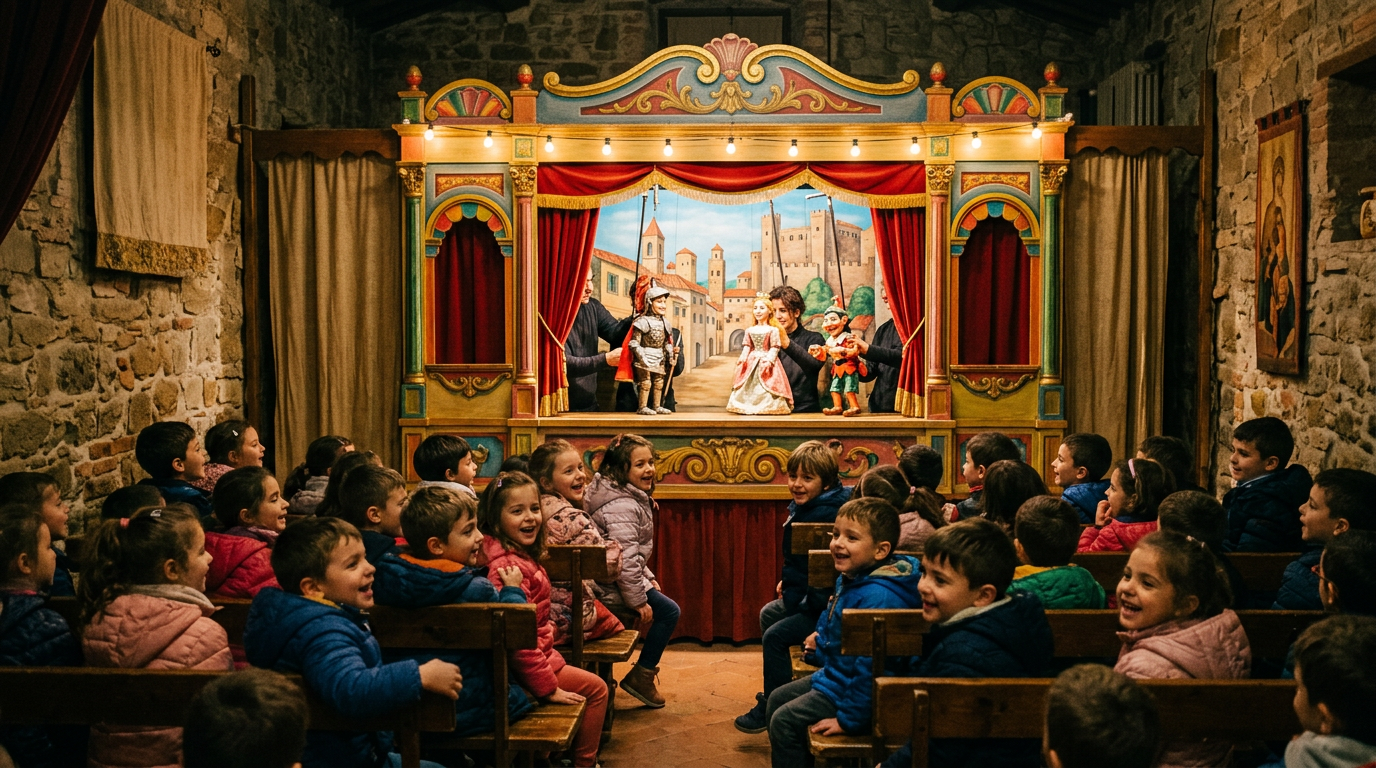
This matters for families because it means that children’s theatre in Florence is not a marginal addition to the adult programme. It is taken seriously, programmed with care, and produced to a standard that takes the child audience as seriously as any adult crowd. The productions that appear in Florence’s children’s and family seasons are not simplified versions of adult theatre. They are productions designed specifically for young audiences, using puppetry, physical performance, original music, and visual storytelling in ways that work across language barriers. A child who does not speak Italian can follow a well-staged Florentine puppet show without difficulty.
Attending a performance during a Florence stay is also, practically speaking, one of the best ways to be in the same room as real Florentine families with children - a dimension of the city that standard tourist itineraries rarely reach.
Which theatres run dedicated children’s programmes
Teatro della Pergola (Via della Pergola 12) is the historic centre of Florence’s theatrical life. Its main programme focuses on adult classical and contemporary theatre, but its education and outreach strand includes a dedicated family and children’s season. Productions are staged both in the main theatre and in the smaller attached Saloncino space. Children’s shows typically run on Sunday mornings, with curtain at ten thirty and a running time of about sixty to seventy-five minutes. Tickets for children’s matinees cost between eight and twelve euros per person. The theatre is a beautiful room - gilded, intimate, and technically sophisticated - and being inside it with young children who are watching something specifically made for them is a genuinely special experience.
Teatro Verdi (Via Ghibellina 99) is a large theatre seating around fifteen hundred people. Its family and children’s programming tends to be more spectacular in scale: musical theatre, large-cast productions, dance performances with theatrical staging. The size of the Verdi means productions can use large sets and full-company casts in a way that smaller theatres cannot. Family event tickets range from ten to twenty-five euros. The theatre has full access including lift facilities, which makes it straightforward with pushchairs and wheelchairs.
Teatro di Rifredi (Via Vittorio Emanuele II 303) is a smaller, more experimental venue in the residential Rifredi neighbourhood, about three kilometres north of the centre. It seats around two hundred people and programs children’s theatre, puppet shows, and physical performance with a contemporary sensibility. The intimacy of the room works particularly well for puppetry and physical theatre, where the connection between performer and audience is part of the effect. Tickets are typically six to ten euros for children’s performances. Reachable by tram line T2 from the city centre in about fifteen minutes.
Teatro del Sale (Via de’ Macci 111) in the Sant’Ambrogio neighbourhood is a members’ club that combines theatre with a shared dinner. Annual membership is about seven euros per adult. Once enrolled, you can attend performances and eat a communal buffet dinner for around twenty-five to thirty euros per adult. Children’s events are periodic rather than regular, but the ones that do happen are well-regarded by local families who use the club regularly.
How the theatrical year is structured
The Florentine children’s theatre season runs from October through May. July and August see most theatres closed or operating at reduced capacity; summer outdoor events and open-air cinema fill part of the gap.
The Christmas period (December through early January) is the most concentrated moment for children’s theatre. Fairy-tale productions, puppet spectacles, and musical performances fill the calendar across multiple venues. These are the events that local families plan months in advance, and booking well ahead is genuinely necessary.
Carnevale (February) is the second peak. Productions themed around masks, transformation, disguise, and comedic reversal appear throughout the season. The Italian Carnival tradition has deep roots in theatrical culture - commedia dell’arte grew from carnival performance - and the productions from this period often carry that improvisational energy even in fully scripted form.
Easter (March through April) brings a third surge of programming, with family productions that draw on historical material, fairy tale, and fantasy. Florentine Renaissance history provides a particularly rich source for this kind of storytelling.
Theatre programmes for the following season are usually published in September. Looking at theatre websites in September gives you the fullest picture of what will be available during a winter or spring visit.
Getting tickets without complications
Online booking through each theatre’s own website is the most straightforward method. Both the Pergola and the Verdi have their own booking platforms with an English-language option. Expect a service charge of one to two euros per transaction.
Vivaticket handles online ticket sales for several Florence theatres and applies a similar booking fee. For last-minute visits, physical box offices open about two hours before each performance. On popular children’s shows, the queue can run twenty to thirty minutes - buying online in advance removes this entirely.
Concession rates for children are standard across Florence theatres. The most common structure is a flat children’s rate for ages three to twelve, typically two to four euros below the adult price. Family packages covering two adults and two children are available at several venues at a discount of roughly fifteen to twenty percent. Children under three are generally admitted free but sit on a parent’s lap - confirm this with the specific theatre when booking, as policies vary.
The right age for a first theatre visit
For puppet shows and physical theatre productions - which use movement, colour, and music as primary storytelling tools with minimal dependence on language - three to four years is a reasonable starting point. Running times are usually forty-five to sixty minutes, within the sustained attention range of most children that age.
For musical theatre productions, five and above works well. The combination of music, movement, and visual spectacle maintains attention more robustly than pure spoken drama.
For spoken drama, even when the physical staging is strong, six to seven is more practical - not because younger children cannot attend, but because the experience becomes richer when children can follow a dramatic arc rather than only reacting to visual moments.
The best single indicator is your child’s previous experience with live performance. A child who has been to a concert or a circus has already developed the skill of attending to something on a stage. For a first-ever live experience, a forty-five-minute puppet show is a better introduction than a ninety-minute musical with a complex plot.
Charlotte is a short walk from both the Teatro della Pergola and a tram or bus connection to every other theatre on this list. If a children’s theatre visit is part of your Florence plans, let us know your dates and we can check what is currently scheduled. Find out more at Charlotte.