Souvenirs for Children in Florence: Original Ideas
The souvenirs worth bringing home
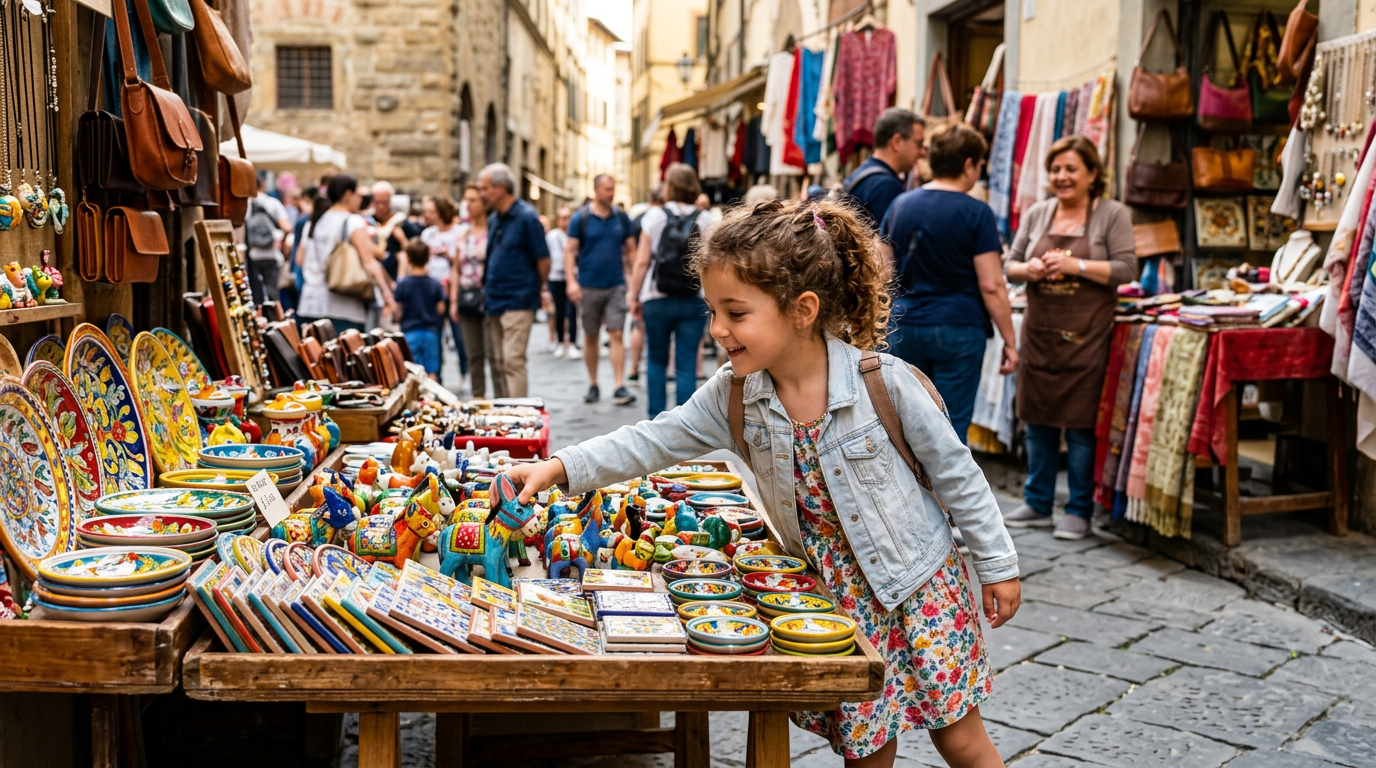
The stalls near major monuments sell the same dozen items in a continuous loop: miniature marble Davids, rubber Pinocchios, pizza-shaped fridge magnets, and leather belts made in China rather than Tuscany. None of these objects have any connection to real Florentine culture, and most of them will sit at the back of a drawer within a week of arriving home.
Florence has a genuine craft and artisan tradition. It has extraordinary museum shops. It has specialist bookshops, professional art supply stores, and paper workshops that teach techniques going back five centuries. Getting children something that reflects the city they actually visited - something with a story attached to it - costs no more than the generic merchandise near the Uffizi and lasts considerably longer as a memory.
Gifts rooted in Florentine craft: the Oltrarno and the centre
The Oltrarno, the neighbourhood south of the Arno, is where Florence’s artisan tradition has survived most intact. The streets around Via Maggio, Via dei Serragli, and Piazza Santo Spirito are lined with workshops where furniture restorers, leather workers, paper marbling studios, and ceramicists actually work. Wandering through this neighbourhood with children is itself an education.
A small carved wooden figure from an Oltrarno craftsperson - a proper artisan piece, not factory-produced - costs between fifteen and forty euros depending on size. It is made in the city, by a real maker, and it will not break. This is categorically different from a plastic Pinocchio from a tourist stall, even at the same price point.
Il Papiro, with its main shop near the Duomo and branches elsewhere in the centre, sells traditional Florentine marbled paper products: notebooks, boxes, bookmarks, pencil cases, and wrapping paper. The swirling patterns are made using a technique brought to Florence from Turkey in the sixteenth century. A marbled paper notebook costs between eight and fifteen euros. The shop also sells kits that allow older children to recreate the marbling technique at home - these cost around fifteen to twenty-five euros and include the paper, instructions, and pigment. For a child who enjoys making things, this is an ideal souvenir.
Zecchi on Via dello Studio is a professional artist supply shop that has served Florentine art students and practising artists since 1952. It sells watercolours, brushes, charcoal, sketchbooks, and everything else a working artist needs, at trade prices rather than tourist prices. A quality watercolour set costs about twelve to twenty euros; a linen-covered sketchbook costs eight to fifteen euros. For a child who likes drawing or painting, being equipped from the same shop that supplies the city’s art schools is a genuine thing.
Museum shops worth visiting in their own right
The Uffizi Galleries shop, accessible from the museum or separately, stocks a range of publications for children explaining the gallery’s major works in clear and engaging language. These books - proper publications, not tourist pamphlets - introduce children to Renaissance art through full-colour images and simple text. Prices range from ten to eighteen euros, and several are available in English. A print of a specific painting the child has seen and responded to makes a souvenir with a direct personal connection. Prints from the official Uffizi shop start at around five euros and come in a cardboard sleeve.
The Palazzo Vecchio museum shop carries a well-illustrated children’s guide to the palace, aimed at seven to twelve-year-olds, with activities and a narrative designed around the building’s history as the seat of Florentine government.
La Bottega dei Ragazzi at the Istituto degli Innocenti on Piazza Santissima Annunziata is worth visiting separately, not just for the shop. The Innocenti was the world’s first purpose-built orphanage, designed by Brunelleschi in the early fifteenth century. The children’s bookshop inside stocks educational books, games, and toys for children up to about twelve, and the building itself - with its famous loggia and the glazed terracotta roundels of swaddled infants above the arches - is one of the most beautiful in Florence.
Toy shops with real character
Città del Sole on Via dei Servi has been Florence’s leading educational toy shop for decades. It stocks wooden puzzles, construction sets, science kits, craft materials, and building toys from quality Italian and European manufacturers. Nothing in it is plastic tat. A good wooden puzzle costs between twelve and twenty-five euros. The staff are knowledgeable and will advise on age appropriateness without being condescending. The shop has a calm atmosphere that is itself a relief after the market streets of San Lorenzo.
Bazar del Prete on Via degli Alfani is a small, old-fashioned shop selling traditional Italian board games, card games, and wooden toys. It has an atmosphere entirely unlike any chain toy shop - organised eccentrically, presided over by people who know their stock, stocked with things you cannot find in supermarkets. A traditional Italian card game to play during the holiday costs about five to eight euros.
Food as a souvenir
Food gifts are often the most practical and most appreciated, particularly for children who want to share something from their trip with friends and family at home.
A small tin of Tuscan honey from a market vendor - acacia or chestnut honey from the Chianti zone - costs about five to eight euros for a 250-gram jar. It is made in Tuscany, tastes completely different from supermarket honey, and a child can bring it to school and tell their classmates they bought it at the market in Florence. A jar of locally produced extra-virgin olive oil, typically available from the same market vendors, makes a similarly specific and useful gift.
The Mercato Centrale ground floor has vendors selling vacuum-packed dried porcini, local lentils, and handmade pasta in decorative packaging - all food products that travel well and taste of where they came from.
Charlotte’s position near the centre means we are within easy reach of the Mercato Centrale, the Oltrarno workshops, the Uffizi shop, and Via dei Servi. Ask at reception if you want specific shop recommendations based on your children’s ages and interests. We are at Charlotte.