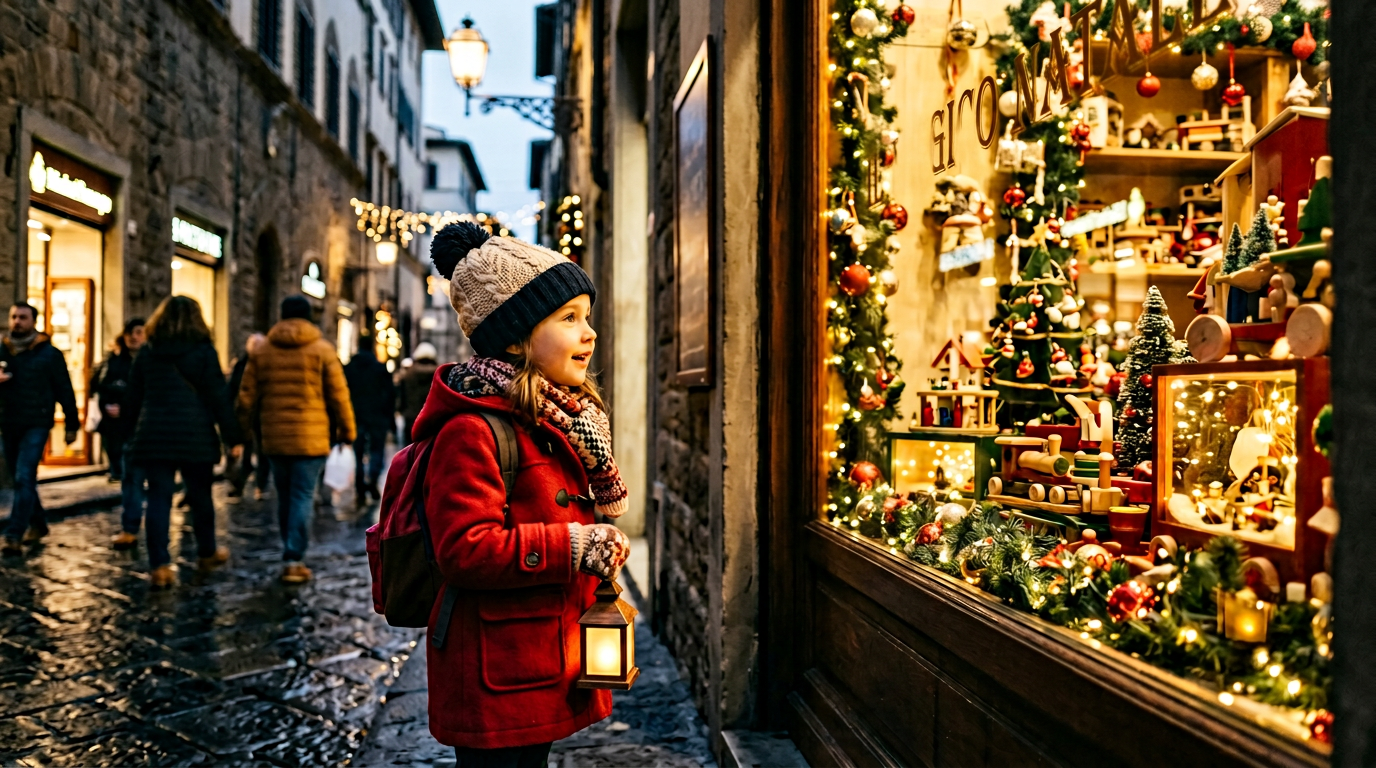
What to Do at Christmas in Florence with Children
Take Florence in July, subtract two-thirds of the visitors, add low amber light, steam rising from a cup of hot chocolate, and the sound of bells from the Duomo on Christmas Eve: that is December in Florence. It is a better city in winter than most people expect, and with children it is surprisingly manageable.
The festive season runs meaningfully from the 8th of December - the Feast of the Immaculate Conception, a national public holiday - through to the 6th of January, when the Befana tradition marks the end of the Italian Christmas. That is nearly a month of markets, concerts, decorated streets, and events specifically aimed at families. This guide covers all of it.
The Seasonal Markets: What to Visit and When
Florence does not have one defining Christmas market in the way that Strasbourg or Nuremberg do. What it has instead is a scatter of markets across the city, each with a slightly different character. Knowing which one suits your family saves time.
The Weihnachtsmarkt in Piazza Santa Croce is the oldest and best known. It grows out of Florence’s twin-city relationship with Nuremberg, and it shows: German timber stalls, Glühwein (served as vin brulé here), hand-carved wooden toys, and Lebkuchen alongside Tuscan cantucci and torrone. Around eighty stalls in all, running from late November through the 26th of December, daily from 10:00 to 21:00 on weekdays and to 22:00 at weekends. Entry is free. The piazza looks best after dark, from around 17:30, when the lights pick out the Gothic facade of Santa Croce behind the stalls.
The Fierucola dell’Immacolata in Piazza Santissima Annunziata happens on the 8th of December. This is a single-day organic and artisan market that draws a more local crowd than the Santa Croce event. Handmade soap, natural cosmetics, organic honey, woven textiles, dried herbs - not the place for Christmas trinkets but genuinely pleasant to spend an hour in, and the square itself is one of the most beautiful in Florence.
The Bazar Natalizio at the Stazione Leopolda runs across two or three December weekends, typically the ones closest to Christmas. The Leopolda is a converted 19th-century railway depot near the Cascine park - a big, high-ceilinged indoor space that feels properly festive. It mixes artisan food producers (excellent for edible gifts and local olive oils) with design shops, clothing, and children’s workshops. Entry costs between 2 and 5 euros for adults; children typically enter free. Check the Leopolda’s website for the exact 2026 dates.
The Mercato Centrale on Via dell’Ariento runs a small seasonal extension in its external arcade during December. This is less a Christmas market than a practical detour: truffle products, aged Pecorino, locally produced honey, good olive oil, seasonal chestnuts. Spending thirty minutes here before or after the food hall upstairs is always worthwhile.
Lights and Decorations Across the City
Florence puts up its Christmas lights gradually through late November. By the first week of December, most of the main pedestrian routes are decorated.
Via dei Calzaiuoli - the wide pedestrian street connecting the Duomo to Piazza della Signoria - carries the most consistently good decorations. The lights here are reliably well-designed, suspended high enough across the street that you get a proper canopy effect. Walking it at dusk with children who have never seen it before produces reliable delight.
Piazza della Repubblica has the city’s most prominent Christmas tree each year, and the historic carousel that sits in the square through the year is dressed up for the season. The carousel, with its painted wooden horses, is the sort of ride that children between two and eight find quietly magnetic. Tickets are around 1.50 euros.
Via Tornabuoni - the city’s luxury shopping street - invests heavily in its window displays for December. This is a different aesthetic from the market stalls: subtler, more expensive, worth a slow evening walk. The route from Ponte Santa Trinita to Piazza Antinori takes about twelve minutes and gives you some of the finest window dressing in Italy.
The Basilica di Santa Croce often projects a light installation onto its facade during December evenings. This runs from approximately 18:00 and is visible at no cost from the piazza - which also happens to be where the Weihnachtsmarkt is. The combination of the market, the lit-up basilica, and the evening atmosphere makes the 17:30-to-19:00 window the best time of the whole day to be in that part of the city.
Theatre, Concerts, and the Befana
Florence’s theatres run strong children’s programmes through December and into January.
The Teatro della Pergola on Via della Pergola 12 is one of the oldest theatres in Italy - a proper horseshoe-shaped 17th-century house with balconies and gilt. Its December and January programme for families ranges from puppet shows and fairy-tale productions to children’s operas and musical performances. Tickets for children’s shows run from around 8 to 15 euros. Weekend performances book out early, so check the programme as soon as you know your travel dates.
The Teatro Verdi on Via Ghibellina 99 seats around 1,500 people and programmes family concerts and seasonal shows over Christmas. The sightlines are good from most of the house. Ticket prices for family events range from 10 to 25 euros depending on the production.
The Museo dei Ragazzi at Palazzo Vecchio runs special winter workshops in December and January, often tied to medieval and Renaissance traditions around Christmas and Epiphany. These are ninety-minute sessions in the palace rooms, costing around 6 euros per child. If you are visiting Florence over Christmas, book one of these alongside the Scoppio del Carro calendar.
The Befana on the 6th of January is the final act of the Italian festive season. In folk tradition, an old woman on a broomstick delivers sweets and gifts to well-behaved children and a lump of coal to the naughty ones. Piazza della Repubblica typically holds a dedicated programme on the morning of the 6th - street performers, character appearances, and enough general chaos to delight anyone between four and ten. It is a genuinely Italian occasion with very little tourist veneer and worth staying for if your trip extends that far.
Keeping Children Warm: Practical Cold-Weather Guidance
Florence in December sits at a different kind of cold from the Alpine resorts. Daytime temperatures typically range from 4°C in the early morning to 12–14°C by mid-afternoon. Evenings drop back to 3–7°C after 18:00. Frost is occasional but not common in the city centre itself.
The challenge is not the temperature in isolation - it is that Florence is a walking city. The historic centre requires movement through outdoor space, across stone pavements and bridges, and along streets that channel cold air. Children who are adequately dressed for the journey from a heated hotel to a nearby museum are often underdressed for an evening at an open-air market.
Layer properly. A thermal base layer next to the skin, a warm mid-layer, and a waterproof and windproof outer shell gives you flexibility as conditions change through the day. A thick single coat is harder to adjust as you move between outdoor markets and heated indoor spaces.
Waterproof footwear matters more than most parents anticipate. December in Florence averages eight to ten days of rain. Stone pavements become slick when wet, and ordinary trainers are soaked through within an hour of light rain. Waterproof shoes or ankle boots with a grip sole are essential for children.
Hats and gloves are non-negotiable for evening outings. Young children lose body heat quickly from the head, and a good hat reduces heat loss dramatically. Carry a spare pair of gloves: one pair always gets lost.
Museums are typically kept between 18 and 22 degrees. Dress children in layers that can be removed in the cloakroom and replaced on the way out. No one enjoys a hot, overdressed child in a confined gallery.
Families who book December at Charlotte often say it is the most relaxed version of Florence they have ever experienced - quieter streets, kinder queues at the galleries, a city that reveals itself more slowly and more generously when the summer urgency has gone.