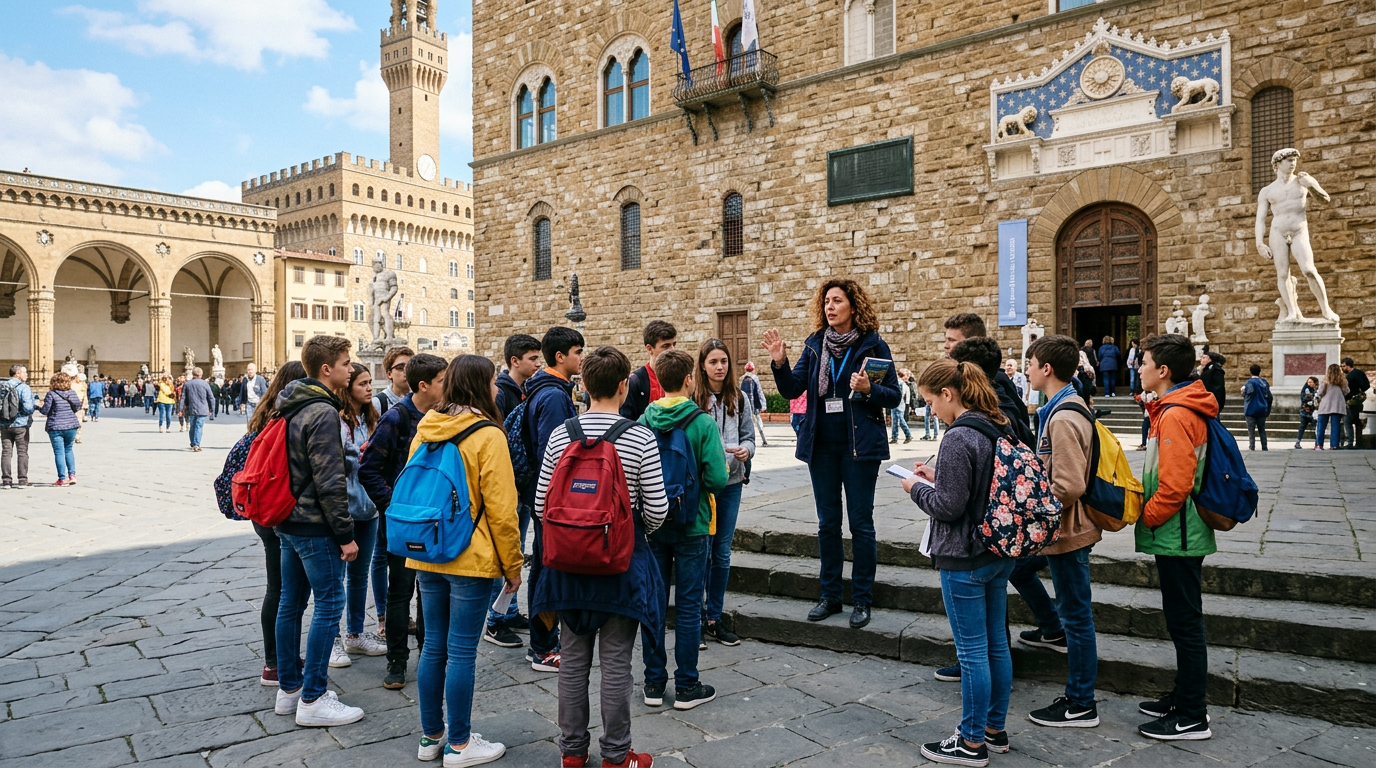
Planning a School Trip to Florence: Full Guide
A school group arrives in Florence with two days, maybe three. The choice of where to take them and in what order determines whether the trip becomes a cultural reference point they carry for years or a blurred sequence of rooms they largely forget. Florence has enough genuine educational material for a month of meaningful visits, which means the real job for a teacher or group leader is selection, not addition. Three well-chosen venues, approached with a coherent theme and prepared reading, will do more for a class than seven rushed stops.
Selecting the Right Museums for Your Curriculum
The Uffizi Galleries are the natural centrepiece for any secondary school group with an art or history focus. The collections hold the most significant concentration of Italian Renaissance painting anywhere in the world: Botticelli’s Birth of Venus and Primavera, Leonardo’s Annunciation, Raphael’s Leo X, and several hundred other works that constitute the core of the canon. Entry for students on official school visits is 1 euro per student. Teachers and one accompanying adult per 10 students enter free. The Uffizi’s dedicated educational department, the Uffizi Edu team, delivers structured thematic visits led by museum educators in sessions of approximately 90 minutes, adapted to different curriculum levels and age groups.
The Museo Galileo, situated beside the Uffizi on Piazza dei Giudici, is the best science destination in Florence for school groups. It holds the original telescopes Galileo used to observe Jupiter’s moons and Saturn’s rings, historical anatomical wax models, Renaissance navigational instruments, and scientific apparatus spanning five centuries. School admission is 6 euros per student. The museum’s laboratory workshop programme - where students handle replicas of historical instruments and conduct simple experiments based on Renaissance scientific methods - is consistently more effective than passive gallery viewing. Workshops accommodate up to 20 students at a time.
Palazzo Vecchio offers school visits structured around medieval civic governance, Renaissance power politics, and the decoration of the Salone dei Cinquecento by Giorgio Vasari. The dedicated school programme includes interactive sessions suited to a range of ages. School entry costs 4 euros per student. The Accademia Gallery, home to Michelangelo’s David, provides a short but focused educational introduction examining how the statue was made and what it represented to Florentines at the time of its installation. Student admission is 2 euros per person for groups of up to 25.
Building the Trip Around a Single Thread
The most effective school trips to Florence are organised around one clear question rather than a checklist of famous places. Several frameworks work well across different age groups and curricula.
How did a single family - the Medici - shape the cultural and physical development of an entire city across three centuries? The Palazzo Medici Riccardi, the Uffizi, and the Palazzo Vecchio together answer this question in sequence, with each venue adding a different dimension. The Centro di Documentazione at Palazzo Medici Riccardi can arrange archival document handling for older students, giving them direct contact with primary source material from the period.
What is the relationship between artistic representation and scientific investigation in 15th-century Florence? The Museo Galileo and the Uffizi address this from different starting points and arrive at overlapping conclusions about observation, precision, and the representation of the natural world.
How does a medieval city get built, financed, and administered? The Palazzo Vecchio, the Duomo, and a well-led walking tour of the historic centre provide the evidence. The Fondazione Romualdo Del Bianco specialises in designing structured cultural itineraries for international school groups and can create a programme matched precisely to your curriculum and student age range.
Practical Arrangements for Group Leaders
Florence’s historic centre is compact. The Uffizi, the Palazzo Vecchio, the Museo Galileo, and the Accademia are all within a 20-minute walk of each other. Plan movement between venues on foot; coaches cannot enter the ZTL (restricted traffic zone) that covers most of the historic centre, and the walking distance from drop-off points to the main museums is significant in any case.
Book all museum visits at least three weeks in advance, and earlier for April to June when the school trip season peaks and educational time slots fill up. The Uffizi in particular has a limited number of educator-led school slots; these are booked through the museum’s educational booking line, which is a separate system from the public ticket office.
Lunchtime with a large group requires advance planning. The first floor of the Mercato Centrale offers a self-service food hall that handles large groups efficiently. Piazza Santa Croce provides a workable outdoor lunch area if the weather is reliable. Piazza d’Azeglio, a quieter garden square east of the Duomo, functions well for groups with packed lunches who need to be seated without disruption.
Educational Services Worth Using
The Museo di Storia Naturale on Via La Pira is well-suited to science and geography-focused groups. Its collections span geology, botany, zoology, and natural history. The presentation is accessible and the admission for school groups runs to approximately 4 euros per student.
Several independent educational tour operators in Florence offer themed walking itineraries of two to three hours. Topic options include Roman Florence beneath the medieval street plan, Dante’s neighbourhood in the late 13th century, and the engineering history of Brunelleschi’s dome. Professional educational guides for a two-hour session start at around 150 euros per group - good value when the alternative is a self-led walk with limited context.
The Uffizi Edu team develops age-differentiated programmes in which primary school sessions focus on observation and storytelling while secondary programmes include art analysis, historical framing, and written response activities. These are well-designed and worth using rather than substituting a standard guided tour.
Groups arriving in Florence need a base that is central, practical, and suited to early morning museum schedules. Charlotte is at Via Guido Monaco 19, five minutes on foot from Santa Maria Novella station and within easy walking distance of every major cultural institution in the city. Enquire about group accommodation and practical planning assistance at Charlotte.