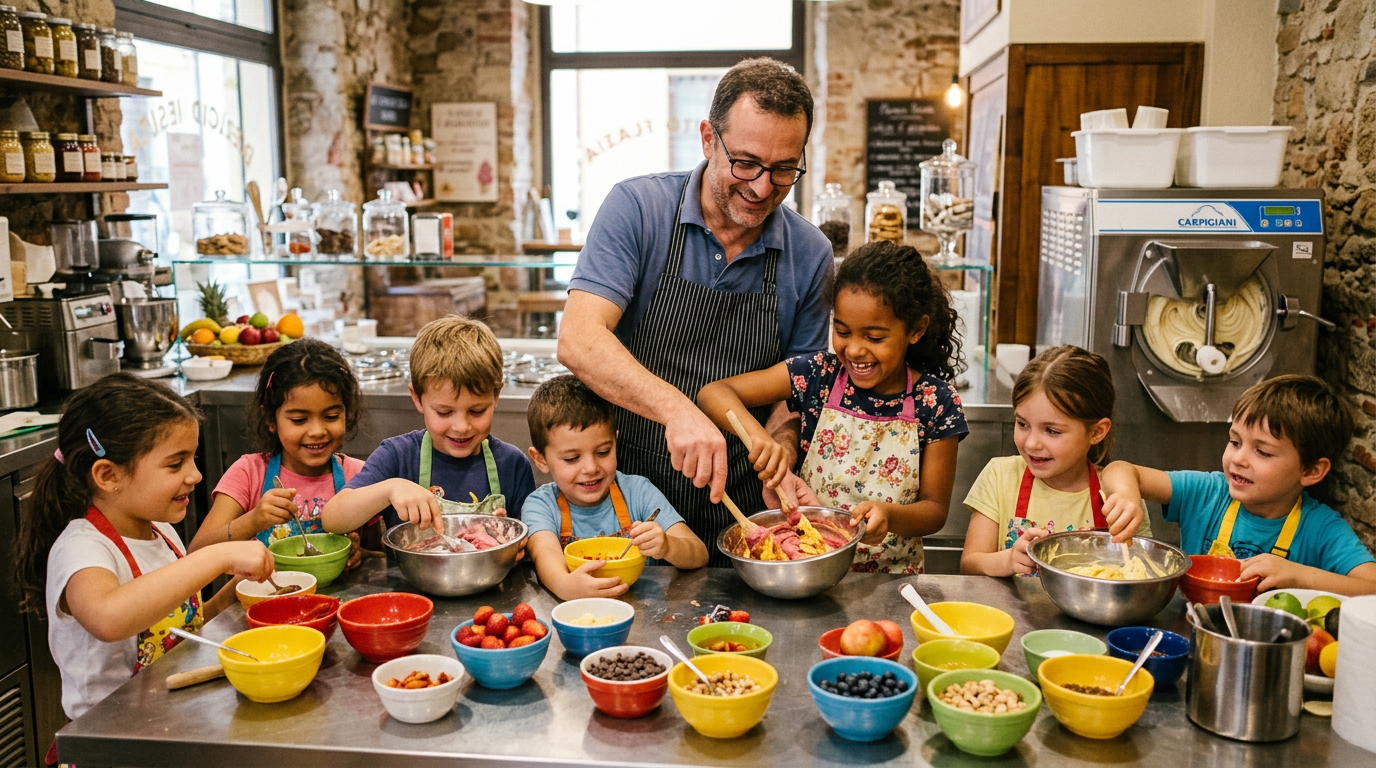
Children's Gelato-Making Course in Florence
There is a moment in every Florence gelato-making course that children simply do not forget: you pour the mixture you have assembled - by hand, with your own measured ingredients - into a professional churning machine, and you watch it thicken and transform in front of you into actual gelato. It takes about eight minutes. By the time the machine stops, children who were perfectly happy eating gelato from a pot off the street have become people with opinions about texture, ingredients, and milk-to-cream ratios. This is either charming or alarming depending on your perspective, but either way it is one of the more lasting things a Florence trip can produce.
Gelato versus ice cream: what the course teaches first
Understanding why gelato is a distinct product from ice cream is the starting point of every serious gelato course in Florence, and it matters because it changes what you are tasting every time you eat it for the rest of your life.
The essential differences are air content and fat content. Ice cream is churned fast, incorporating a large quantity of air - sometimes as much as 50 percent of the total volume is air. Gelato is churned slowly and contains far less air, perhaps 20–30 percent. The result is a product with a much denser texture and a more concentrated flavour. The fat content is also lower in gelato: the base typically uses significantly more whole milk than cream, compared to the cream-dominant base of most ice creams. This is counterintuitive - lower fat, but more intense flavour - and it is the piece of information that tends to reframe how children (and adults) think about what they are eating.
Instructors in Florence explain this history through the lens of the city itself: Bernardo Buontalenti, the 16th-century Florentine architect and polymath, is credited in Italian food tradition as one of the originators of modern gelato, having developed a frozen dessert for the Medici court. Whether the historical claim fully withstands scrutiny is a separate matter; as a piece of context that places children inside the city’s history, it works extremely well.
The science of the churning process - why adding salt to ice lowers its melting point, why certain sugars resist freezing better than others, what determines whether a finished gelato holds its shape at room temperature - is covered in simplified terms that children aged eight and above understand and retain.
Where to find family-oriented courses in Florence
Not every gelato course in Florence is configured for children. Some are technical adult sessions in professional kitchen environments where the pace and vocabulary assume a certain culinary background. When booking for a family, look explicitly for venues that mention minimum age, mixed-age groups, and a format designed around hands-on participation rather than demonstration-plus-watching.
Florencetown, operating from a kitchen space near Piazza della Repubblica, runs gelato courses throughout the tourist season with considerable experience in mixed-age groups. Children from age six are accommodated. The format is genuinely hands-on - every participant works with their own portion of ingredients - and the instructors adjust the technical explanation to the age range in the room. English-language sessions are the standard offering during the tourist season. Group sizes are capped to keep the session manageable.
Gelateria dei Neri on Via dei Neri in the Santa Croce area runs seasonal family workshops from its working gelateria kitchen. The location is in a genuine artisan gelateria rather than a generic cooking school, which gives the experience a credibility and atmosphere that purpose-built teaching kitchens sometimes lack. Availability is limited and seasonal; check their schedule directly.
Apicius International School of Hospitality on Piazza Ottaviani is the most formally structured option. Their family sessions are suited to older children and teenagers who want a more technical approach. The school is professionally run and the gelato component is typically part of a broader Italian desserts session.
For families with very young children or with specific requirements, private bookings are available from most operators. A private session for four to six people can be tailored completely to your family’s pace and interests.
The session itself: what happens and in what order
A standard family gelato course in Florence runs between ninety minutes and two and a half hours, including the eating at the end. The sequence at most venues follows a consistent logic.
The instructor opens with a brief explanation of ingredients - the type of milk, the sugar composition, the role of stabilisers in professional gelato - and the history context described above. This section runs about fifteen minutes and is calibrated to hold children’s attention rather than to be comprehensive.
Then the hands-on work begins. Participants measure and combine their chosen base. The most common choices in family sessions are a milk-based flavour - pistachio, stracciatella, hazelnut, or fior di latte - and a fruit sorbet, usually lemon or strawberry. Both are simple enough for children to manage independently with light supervision. The measurement step, in particular, is something children take seriously: every gram counts, and children who are naturally precise enjoy having their accuracy matter.
The mixture goes into the machine. Waiting for gelato is one of the few culinary processes where the transformation is visible in real time through the machine’s window. Eight to twelve minutes, and the liquid becomes solid. During this window the instructor covers serving technique, temperature management, and why proper gelato is served at a slightly warmer temperature than most commercial ice cream.
At the end, everyone tastes what they made. This is the point of the course, and it consistently delivers. Most children want to make it again immediately.
Age ranges and what they get out of it
Children from age five can participate in basic family-format sessions. At this age the experience is primarily tactile - mixing, pouring, watching the machine - and the conceptual layer lands lightly. The enjoyment is real but different from what older children take from it.
The optimal age window for gelato courses is roughly eight to fourteen. Children in this range can follow the science, handle the equipment with confidence, and leave with a genuine understanding of what they did and why it produced the result it did. Many children in this age group go home and attempt to reproduce a simplified version at home, which may or may not go well but is entirely worth encouraging.
Teenagers from fourteen upward often prefer the adult-format technical sessions, which cover a wider range of flavours, introduce professional equipment in more depth, and treat participants as emerging cooks rather than supervised participants.
Do not bring children under four. The kitchen environment, the requirement to stand for ninety minutes, and the sustained attention needed make it unsuitable for toddlers, regardless of how much they love eating gelato.
Cost, booking, and what to expect when you arrive
Family gelato courses in 2026 are typically priced at €40–70 per person for group sessions. Some operators offer a flat family rate - around €150–180 for two adults and two children - which works out more economically for four-person groups. Private bookings for a family group of four run approximately €200–300 depending on venue and duration.
Florencetown lists adult prices starting around €55 and child prices around €35, all inclusive of ingredients and the final tasting portion.
Book at least five to seven days in advance during the summer, and two weeks or more for August. July and August sessions sell out at the main venues in advance, and arriving without a booking means starting the search for alternatives at the busiest time of year. Most operators accept cancellations with a full refund up to 48 hours before the session; confirm the exact policy before paying.
When you arrive, wear clothes you are willing to get flour or sugar on. Most venues provide aprons but the general principle of gelato-making is that some of the ingredients end up somewhere they were not intended to be, and children in particular take this as a creative freedom rather than a constraint.
Charlotte at Via Guido Monaco 19 is within easy reach of all the venues mentioned in this guide. If you want help choosing the right course for your children’s ages or need advice on booking, the team is glad to help - find us at Charlotte.