Cooking Classes for Families in Florence
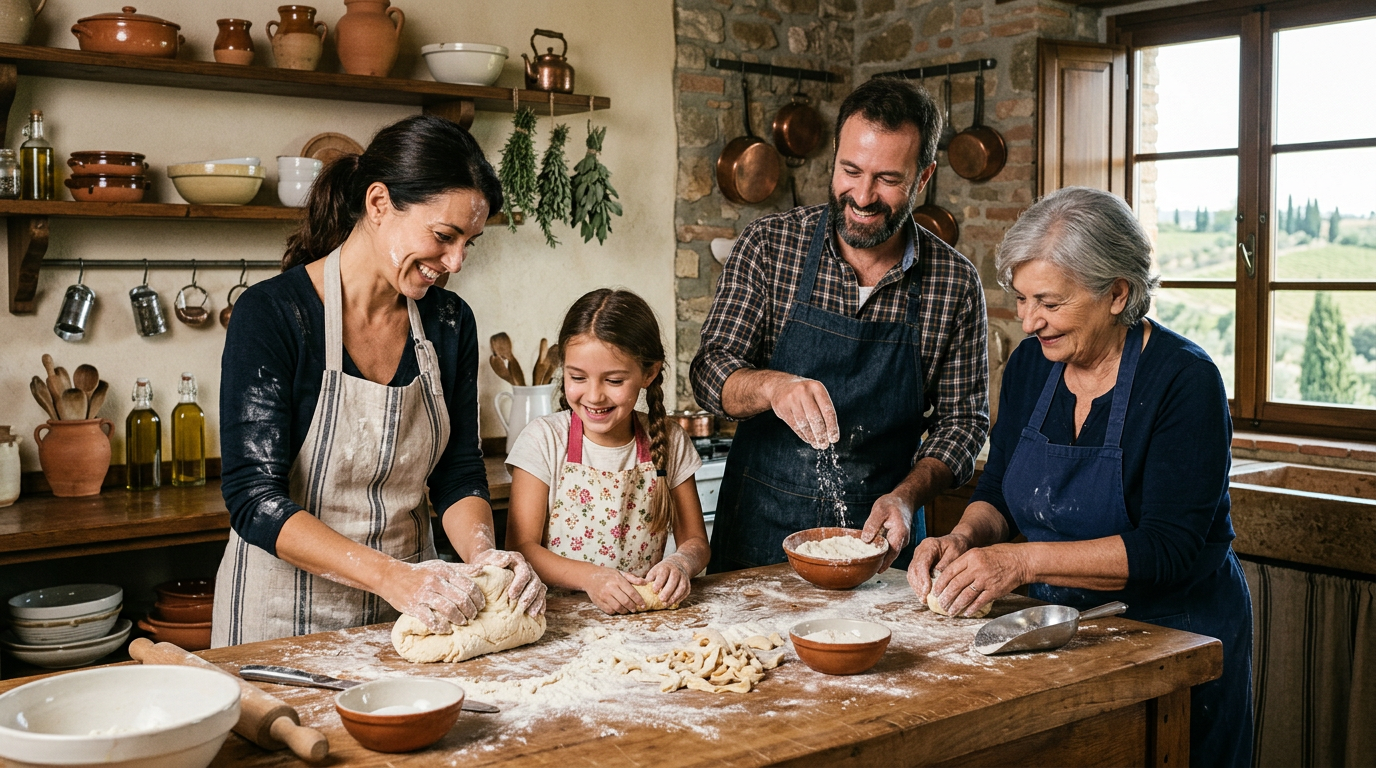
By the third day of a Florence trip, the museum queue fatigue is real and the children are negotiating hard against any further exposure to frescoes. A cooking class is the answer. It is active, it is entirely hands-on, it produces something edible at the end, and it goes directly against every passive component of museum tourism. You stand at a floured worktable in an actual kitchen, you get your hands dirty making fresh pasta, and you sit down to eat a proper meal that you made yourself. Children find this satisfying in a way that is genuinely difficult to replicate with any other Florence activity.
Choosing the right class format for your family
Not all cooking schools in Florence are configured for children. Many offer excellent adult-focused sessions that assume a certain level of patience and technical interest that a seven-year-old cannot be expected to match. When you book, you want a class that specifically describes itself as family-friendly - ideally one that mentions the minimum age, uses tables at child height, and has instructors who have taught mixed-age groups before.
The most child-accessible formats are fresh pasta making and pizza making. Both are tactile, both have immediate and visible results, and neither requires the kind of sustained standing and listening that puts young children off. A pasta-making session involves working the dough with your palms, rolling it with a rolling pin or a hand-cranked machine, and cutting the resulting sheet into tagliatelle or pappardelle. Children aged five and up can do every step of this. The dough is forgiving, the technique is learnable in about three minutes, and the transformation from flour and eggs to a silky sheet of pasta has a genuinely satisfying logic.
Pizza making follows a similar trajectory: you mix and prove the dough, stretch it by hand (the most entertaining part), add tomato and toppings, and bake. Classes that go in this order tend to work well for children under ten because the activity sustains attention rather than requiring children to wait while adults work.
Longer Tuscan menu classes - three courses, sometimes preceded by a trip to the Mercato Centrale to buy ingredients - are better suited to families with children aged nine and above who can follow a more complex sequence of preparation and are comfortable in a kitchen for three or four hours.
Schools in Florence with proven family programmes
Florencetown, based near Piazza della Repubblica, is one of the most established activity operators in the city. Their family pasta class runs with groups of up to twelve participants and accepts children from age six. The instructors are experienced with mixed ages and the format is designed to be informal and adaptable. A market visit add-on is available for a small supplement. The school’s central location means you are a short walk from the teaching kitchen regardless of where in the centre you are staying.
In Cucina on Via dei Neri, near the Santa Croce quarter, is a smaller school with a reputation for relaxed and genuinely instructive sessions. They have run family pasta classes for several years and accept children from age five when accompanied by a parent. The space is compact and intimate, which works well for smaller family groups. Their instruction style leans practical rather than theatrical - you learn technique that you can actually reproduce at home, which is arguably what you want from a cooking class.
Giulio Divino near Piazza Santa Croce offers a family Tuscan lunch class that covers a two-course meal. The atmosphere is convivial and communal, with participants sharing a table at the end. Children from age seven are welcome. This format works particularly well when you have a mix of ages in your group - parents and grandparents alongside children - because the shared table element brings everyone together at the end.
For families with very young children (ages three to five) or with children who have specific dietary requirements, a private session is almost always worth the higher cost. Private classes can be adapted entirely to your pace and preferences, and the instructor can slow down or speed up any section based on the group’s engagement.
What you actually make and eat
In a fresh pasta class, you typically start by learning to judge the right consistency of a pasta dough by touch: it should be smooth and elastic, not sticky, with a slight warmth. The ratio is roughly 100 grams of type 00 flour to one medium egg per person. You knead the dough for about ten minutes (longer for children who are enjoying themselves), then rest it, then roll it out. The flour quantity for a family is small enough that children can manage their own individual portions from start to finish, which is the experience worth paying for.
The finished pasta is cooked in front of you and served with a simple sauce - often a sage butter, a sugo di pomodoro, or a ragù - and eaten immediately at a table inside the kitchen or an adjacent dining space. The combination of effort and reward lands particularly well with children. They notice the texture of pasta they have made themselves versus dried pasta from a packet, and most do not forget it.
Pizza classes work best when the instructor lets children go rogue with the toppings. Most Florence pizza classes include a basics-only approach to sauce and mozzarella, with a small selection of additional toppings available. Children who are given autonomy over their own pizza’s surface tend to be fully invested in the outcome.
If the school offers a market visit beforehand, do it. The Mercato Centrale’s ground floor on a weekday morning - the fishmongers, the butchers, the cheese stalls, the fresh herb vendors - is one of the great sensory experiences of Florence, and it contextualises the cooking session in a way that no classroom introduction can match.
Prices, timing, and booking
A family pasta class in 2026 costs approximately €60–70 per adult and €40–50 per child at most schools. For a family of two adults and two children, budget around €200–240. A private family session for four runs from €250 to €400 depending on the school and the format chosen.
The session duration for a pasta or pizza class is typically two to two and a half hours including the meal. A full Tuscan menu class with market visit runs four to five hours.
Book at least seven days in advance in June, July, and August. August in particular books out weeks ahead at popular operators. When booking, always specify the ages of your children - this is not a courtesy note, it is information the school uses to configure the session and assign the right instructor. If one of your children has a food allergy, state it clearly at the time of booking rather than on arrival.
Cancellation terms vary but most reputable operators offer a full refund up to seventy-two hours before the class. Confirm this before payment if your travel plans might need to shift.
A base close to the city’s best kitchens
The main cooking schools mentioned above are spread across the central neighbourhoods of Florence - near Santa Croce, near Piazza della Repubblica, near the Oltrarno. All of them are within twenty minutes on foot from the historic centre. Charlotte at Via Guido Monaco 19 is centrally positioned for all of them, five minutes from Santa Maria Novella station and within easy walking distance of every address in this guide. If you would like a recommendation based on your children’s ages or your travel dates, the team at Charlotte is happy to help point you towards the right session.