Florence Carnival with Kids: What to Do
February half-term is one of the best times to bring children to Florence. The city is quieter than Easter, prices are lower than summer, and Carnival season - which runs from mid-January until Shrove Tuesday - fills piazzas, libraries, and community halls with colour, confetti, and a level of costumed enthusiasm that children find entirely irresistible. Florence is not Venice, and it does not try to be. What it offers instead is something more local, more participatory, and considerably less expensive.
Crafting masks and costumes in the city’s workshops
The single activity that children remember longest from Florence’s Carnival is making something with their own hands. The city has a strong tradition of artisan mask-making, and several cultural organisations run workshops specifically for families during the Carnival weeks.
The Museo dei Ragazzi, housed inside Palazzo Vecchio on Piazza della Signoria, runs themed children’s workshops throughout the year, and the Carnival period is one of the richest. Sessions typically explore Venetian papier-mâché mask techniques or Renaissance-era festival costumes. Booking is essential and opens online through the Palazzo Vecchio website. Expect to pay around €6–10 per child depending on the workshop format.
Libraries across the city’s neighbourhoods - the Biblioteca delle Oblate near Santa Croce, the Villa Bandini library in Oltrarno, and the Biblioteca Mario Luzi near Piazza Beccaria - run free drop-in workshops for children during Carnival. These are genuinely local events, attended mostly by Florentine families rather than tourists. The atmosphere is relaxed, the instruction is warm, and no prior booking is usually needed for the smaller branch libraries. Check the City of Florence’s events calendar at comune.fi.it closer to your travel dates.
For something more artisanal, a handful of craft studios in the Oltrarno quarter - the old artisan neighbourhood south of the Arno - offer paid sessions where children learn to decorate a leather or papier-mâché mask. These sessions are by appointment and worth seeking out if your children are between seven and fourteen. Search Instagram under tags like #maschere #artigianato #firenze for current active studios.
Where the street celebrations take place
Florence’s Carnival street life is concentrated in specific squares and neighbourhoods rather than spread evenly across the city. Knowing where to go makes the difference between stumbling on something wonderful and walking a long way for nothing.
Piazza di Santo Spirito in Oltrarno is consistently the most atmospheric during Carnival weekends. Local traders, neighbourhood associations, and community groups organise events here with music, street food, confetti cannons, and children’s games. It has the feel of a proper neighbourhood celebration rather than a managed tourist event.
Piazza Santa Croce hosts larger-scale public events some years, usually on the Sunday before Shrove Tuesday. These are less predictable and vary year to year. The Muse association and the Quartiere 1 social media channels are the best sources of current information.
Piazza della Repubblica, the grand 19th-century arcaded square in the heart of the city, sometimes hosts commercial Carnival installations with entertainment for children. It lacks the intimacy of the neighbourhood piazzas but is easy to reach and useful if you have very young children who simply need a large, flat space with something happening in it.
The San Frediano and Santa Croce neighbourhoods - both lively, both genuinely residential - often have informal street activity on Carnival Sundays. Keep your eyes open for flyers in café windows and bar noticeboards, which remain more reliable than many online sources for these kinds of community events.
Costumes: hiring, buying, and Tuscan traditions
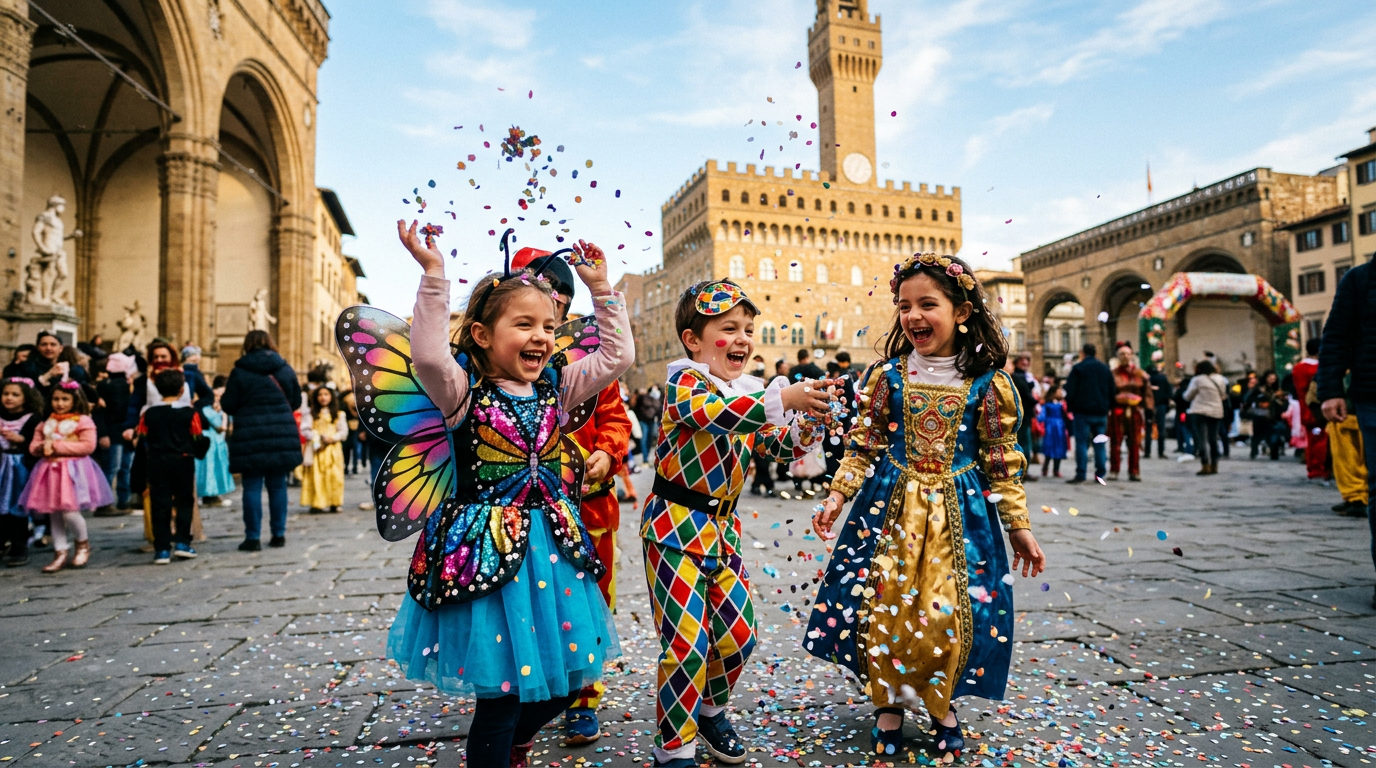
Dressing up is essentially compulsory for children during Carnival in Italy. You will see costumed children everywhere during the peak Carnival weekends, not only at organised events but simply out shopping, at the market, or sitting in bars with their parents eating a brioche. Italians take the whole thing entirely seriously.
If you want to hire or buy a costume in Florence, the streets near Via della Vigna Vecchia and the area around Via dei Servi have small costume boutiques that hire outfits for the weekend. A hire typically costs between €10 and €30 depending on complexity, with a deposit. Buying a simpler costume at one of the market stalls in Via dell’Ariento or at the Tuesday Cascine market is often the more practical choice for younger children who will wear it once and grow out of it immediately.
Florentine Carnival has its own historical tradition of Renaissance-inspired dress. Girls might opt for a velvet cap and brocade dress; boys for a tunic and beret. These costumes reference the city’s actual history rather than generic superhero franchises, and they tend to photograph beautifully against Florentine stonework. Several costume hire shops in the historic centre stock historically inspired options alongside the usual commercial choices.
Standard Commedia dell’Arte characters - Arlecchino, Colombina, Pulcinella - are another traditional option. These are recognisably Italian, travel well across different contexts, and are available almost everywhere at reasonable prices.
Making the most of the Carnival period with children
A few practical points that make the Carnival weeks easier to navigate with children.
Timing matters. The key dates are the Thursday before Shrove Tuesday (known as Giovedì Grasso), the following Sunday, and Martedì Grasso itself. These are the three peak days. If you are in Florence for a weekend during the broader Carnival period rather than one of these peak dates, you will still find workshops and some activity, but the streets will be quieter.
Temperatures in February and early March in Florence can drop to 3–6°C in the evenings. Layer children up. The midday temperatures are often mild - 10–14°C is typical - but costume-wearing children who have been running about get cold quickly when they stop.
Confetti - coriandoli - is part of the experience. Accept that you will be finding it in hair, shoes, and jacket pockets for several days afterwards. Children consider this entirely positive.
The Carnival period falls outside peak tourist season, which means hotel prices are lower, restaurant queues are shorter, and Florentine people are more relaxed and visibly pleased to see visiting families. It is one of the genuinely underrated times to visit the city.
Staying central makes all the difference
When you are working around children’s nap times and energy levels, the distance between your accommodation and the Carnival activity is not a minor detail - it is the thing that determines whether the day works or falls apart at 4pm. Being able to walk back for rest, change out of a costume, and head out again without a bus journey on either side makes an enormous practical difference.
Charlotte is right in the heart of Florence at Via Guido Monaco 19, five minutes from Santa Maria Novella station and a short walk from Piazza della Repubblica, Santo Spirito, and the main Carnival meeting points. If you are planning a Carnival trip with children, start here: Charlotte.