Buying Tuscan Crafts in Florence: What to Look For
The difference between a genuine Florentine artisan piece and a mass-produced souvenir is usually visible within seconds - and audible within minutes. A craftsperson in a workshop on Borgo San Jacopo can tell you exactly which hide the wallet came from, how long it took to stitch, and why the edge burnishing matters. A tourist shop near the Uffizi cannot. Buying the real thing means going to the right places, which in Florence means heading south of the Arno or looking for the workshops that have been quietly doing this for generations.
The categories of Tuscan craft and what they cost
Florence’s artisan tradition covers several distinct areas, each with its own geography and price range.
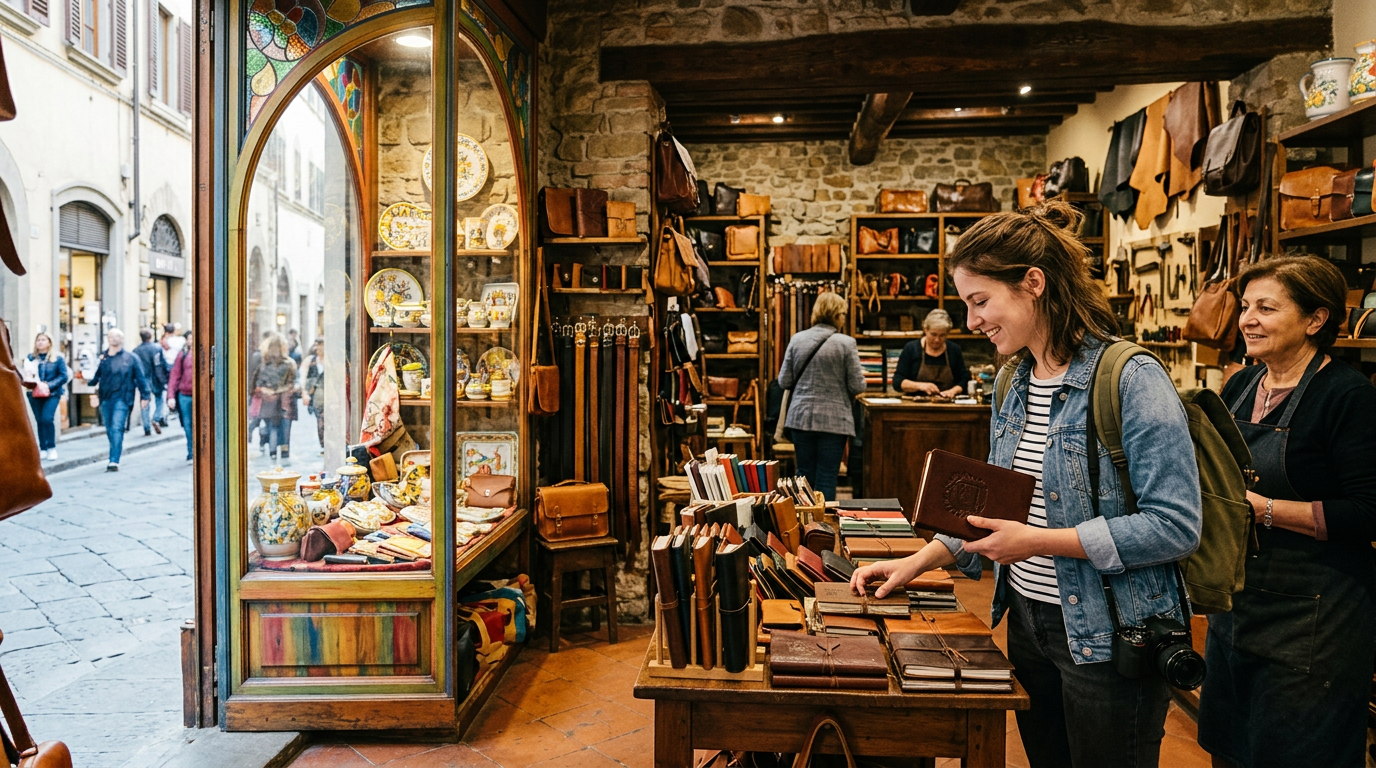
Leather is the most visible. Bags, wallets, belts, gloves, and bound notebooks made from Florentine leather have a texture and durability that factory equivalents cannot replicate. A handmade leather wallet from an established workshop starts at around 30 euros. A bag costs anywhere from 80 euros to several hundred, depending on the maker and the complexity of construction. The Oltrarno neighbourhood is the right place to look - not the market stalls near San Lorenzo, where the sourcing is difficult to verify.
Marbled paper - carta marmorizzata - is produced by floating coloured pigments on a water surface and transferring the swirling pattern to sheets of paper. The technique has been practised in Florence for centuries and produces stationery, notebooks, and boxes that are beautiful and practically indestructible. Small items like bookmarks and cards cost 5 to 8 euros; notebooks run from 15 to 30 euros. This is one of the most transportable and consistently pleasing things to buy.
Ceramics and terracotta include plates, bowls, tiles, and decorative pieces painted by hand with the floral and geometric patterns associated with the Florentine and Tuscan traditions. A single hand-painted tile costs around 10 to 20 euros; a plate or bowl runs between 20 and 50 euros. Look for slight variations in the brushwork - a sign of genuine hand-painting rather than a transfer.
Gold and silver jewellery from small Florentine workshops makes for a considered purchase. The concentration of goldsmiths on and around the Ponte Vecchio means you can browse and compare relatively easily. Prices range from 30 euros for simple silver pieces to several hundred for worked gold.
Craft markets worth visiting
The Piazza dei Ciompi, in the Santa Croce neighbourhood, hosts a flea market every day with antiques, ceramics, and handmade pieces. The last Sunday of each month brings a larger fair with more stalls and a broader selection of genuine artisan goods. Prices here are negotiable for larger items and generally lower than in fixed-address workshops. It is a good place to find unusual Tuscan ceramic pieces and vintage textiles.
The Santo Spirito craft market in the Oltrarno, which runs on the second Sunday of each month, showcases contemporary artisan production. Jewellers, textile makers, woodworkers, and potters display their work in the piazza in a setting that is genuinely pleasant for browsing with children. The atmosphere is relaxed, vendors are happy to talk about their work, and prices are moderate.
The Artigianato e Palazzo fair, held each year in the gardens of Palazzo Corsini usually in May and September, brings together more than sixty master craftspeople from Tuscany and beyond. This is the most concentrated opportunity to buy directly from makers in a single visit. Entry costs around 10 euros for adults. If your dates in Florence coincide with it, do not miss it.
Historic workshops in the Oltrarno
The south side of the Arno has been Florence’s working artisan district for centuries, and it remains so today. Streets including Via Maggio, Via dello Sprone, and Borgo San Jacopo are lined with small businesses where you can watch work in progress through open doors.
The Scuola del Cuoio - the Leather School - is located within the Santa Croce Basilica complex and has been operating since 1950. It functions as both a teaching institution and a retail workshop: you can watch artisans stitching and finishing goods from a viewing gallery, then buy from the same workshop. Wallets start at approximately 30 euros; bags from 80 euros upward. Everything sold here is made on the premises.
Il Papiro, which has several branches across the city, is one of the oldest marbled paper producers in Florence. The demonstration of the technique - pigments floating on a water bath, a comb dragged through the surface - takes about two minutes to watch and is reliably fascinating for children. Prices start at around 8 euros for smaller pieces. It is one of the most giftable things you will find in the city.
For ceramics, a short drive or train journey to villages in the Chianti opens up workshop visits where you can watch pieces being made and painted. Ceramiche Rampini near Radda in Chianti is a well-regarded option and ships internationally for larger purchases.
What to buy for children, and what to avoid
Children respond most readily to crafts they can touch, use, or relate to a story. A small hand-carved wooden toy from a woodworker near Piazza San Marco, a hand-painted ceramic tile they chose themselves, or a marbled paper notebook in their favourite colours will be used and remembered long after a factory-made keyring is forgotten.
The Pinocchio question comes up on almost every family visit to Tuscany. The mass-produced Pinocchio figures displayed on rotating racks outside tourist shops throughout the centre are made in factories, not workshops, and bear no meaningful connection to Florentine craft traditions. If you want a wooden Pinocchio that has been genuinely carved from Italian wood by a craftsperson who cares about the result, go to a woodwork shop in the Oltrarno and ask specifically for a handmade piece. The price will be higher - expect 25 to 60 euros depending on size - and the difference in quality is immediate.
The Libreria dei Ragazzi on Via de’ Servi sells illustrated children’s books produced by Italian artisan publishers. A beautiful illustrated book, even in Italian, makes a meaningful and portable souvenir that connects children to the culture they have been visiting.
Telling genuine crafts from imitations
The simplest test is to ask. A maker who produced something by hand can answer questions about it: the materials used, the technique, how long it took, what makes this piece different from the last one. A vendor selling factory goods usually cannot engage beyond the price.
Genuine artisan pieces show small irregularities: a slight variation in the marbled pattern, a minor difference in the depth of a carved line, a brush stroke that is not machine-perfect. These are features, not flaws. Factory production achieves perfect uniformity; hand production does not.
The Consorzio Artigianato Fiorentino certifies participating workshops as genuine Florentine producers. The Artex Centre on Via dei Fossi is a non-profit body that supports the city’s craft traditions and publishes a directory of certified workshops - a practical resource for families who want to be certain of what they are buying.
Florence rewards the kind of browsing that takes you off the main tourist routes and into the workshop streets of the Oltrarno. The walk from Santa Maria Novella station to the Oltrarno takes around fifteen minutes on foot - and if you are staying at Charlotte, at Via Guido Monaco 19, you are already most of the way there before you begin.